How to Use a Multimeter: A Beginner's Guide (Volts, Ohms, Continuity, Amps)
Learn to use a multimeter step by step: every dial symbol, which hole each probe goes in, and how to measure volts, ohms, continuity and amps safely.
ON THIS PAGE
- Free multimeter simulator
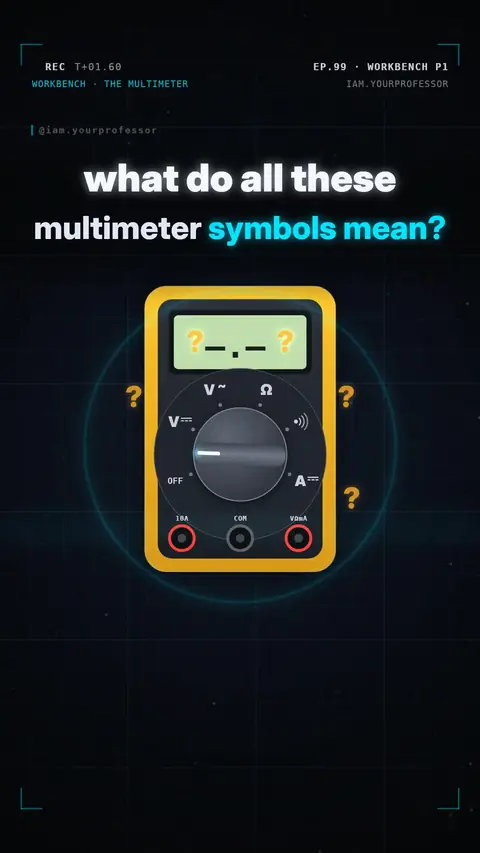
- The multimeter dial: every symbol explained
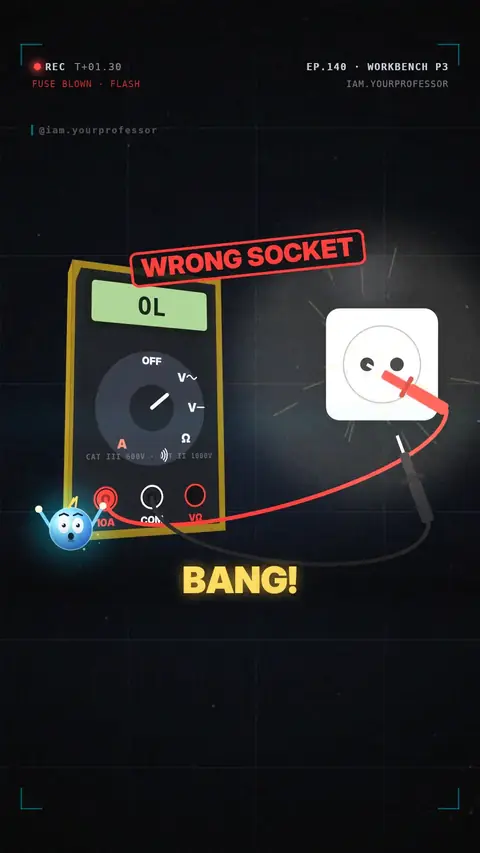
- Which hole does each probe go in?
- How to measure voltage (a battery)
- Measuring a wall socket (only if trained)
- How to measure resistance
- How to do a continuity test (the beep)
- How to measure current (amps)
- Choosing your first multimeter
- Frequently asked questions
A multimeter is the one tool every electronics hobbyist, student and DIYer needs. It tells you if a battery is dead, if a wire is broken, what a resistor really is, and much more. This guide takes you from "what are all these symbols?" to your first safe measurements.
Free multimeter simulator
Practise without any risk: turn the dial, plug the probes in and measure batteries, a socket, wires and LEDs. Then try the job cards.
⚡ LOADING THE CALCULATOR…
Free, no sign-up. Prefer a bigger screen? Open the Multimeter simulator calculator in the Lab →
The multimeter dial: every symbol explained
| Symbol | Name | Measures | Use it for |
|---|---|---|---|
| V⎓ (V with a straight line) | DC voltage | Steady voltage | Batteries, USB, Arduino, car |
| V~ (V with a wave) | AC voltage | Alternating voltage | Wall sockets (with care!) |
| Ω | Resistance | Ohms | Resistors, heaters, sensors |
| Beep / sound waves | Continuity | Is there a connection? | Broken wires, fuses, switches |
| Diode arrow | Diode test | Forward voltage | Diodes, LEDs, transistor junctions |
| A⎓ / A~ / mA | Current | Amps flowing | Battery drain, circuit current |
| F / ⊣⊢ (some meters) | Capacitance | Farads | Capacitors |
| Hz (some meters) | Frequency | Cycles per second | Mains, signals |
Which hole does each probe go in?
- COM (common): the black probe. Always.
- VΩ (often also mA, beep, diode): the red probe for almost everything.
- 10A (or 20A): the red probe only to measure big currents.
- mA / µA: the red probe for small currents (has a small fuse inside).
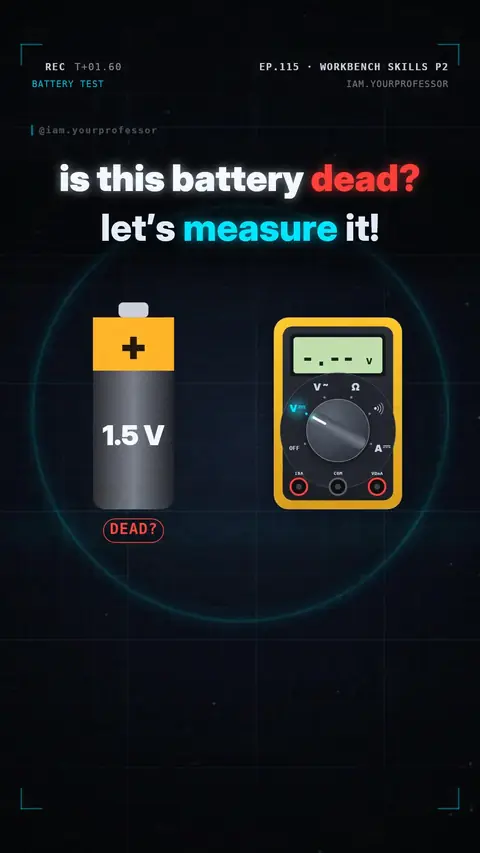
How to measure voltage (a battery)
- Red probe in VΩ, black in COM.
- Dial to V⎓ (on a manual meter choose the 20 V range).
- Red probe on the battery's +, black on −.
- Read it: a fresh AA shows about 1.5–1.6 V; below about 1.2 V it is nearly empty. A 9 V battery reads about 9.5 V fresh.
- Probes the wrong way round? You just see a minus sign — no harm done on DC.
Measuring a wall socket (only if trained)
Mains is 230 V · 50 Hz in India, the UK and Europe, and 120 V · 60 Hz in the USA and Canada. Use V~, a meter rated CAT II / CAT III for mains, probes with finger guards, and one hand. If you are not sure — don't. Practise on batteries.
How to measure resistance
- Switch the circuit off. The Ω mode uses the meter's own small battery; outside voltage gives wrong readings or can damage the meter.
- Dial to Ω. Touch the probes together first: it should read close to 0 Ω.
- Touch the probes to both legs of the resistor. Don't hold both legs with your fingers — your body is in parallel and changes the reading of large resistors.
- For a resistor still on a board, lift one leg — other parts in parallel can change the reading.
Compare with the resistor colour code: a 1 kΩ ±5 % resistor can read anywhere from 950 to 1,050 Ω.
How to do a continuity test (the beep)
The beep mode answers one question: is there a path between these two points?
- Power off. Dial to the beep / sound symbol.
- Touch the probes together: it beeps.
- Put one probe on each end of a wire, fuse or switch. Beep = connected. Silence = broken.
Great for finding a broken charging cable, a blown fuse, or which pins of a switch connect.
How to measure current (amps)
Current is the one measurement that is done differently:
- Open the circuit and put the meter in series so the current flows through the meter.
- Move the red probe to mA (small currents) or 10A (big ones). Start with 10A if you don't know.
- Dial to A⎓ (or A~).
- Read the current, then move the red probe back to VΩ.
Choosing your first multimeter
- Auto-ranging (no need to pick 2 V / 20 V / 200 V ranges).
- Continuity beep that is fast.
- CAT II 300 V minimum; CAT III 600 V if you will ever touch home wiring.
- Fused current inputs and probes with finger guards.
- Safety marks: UL / ETL (USA), CE / UKCA (Europe / UK), BIS (India).
Turn the dial, plug in the probes and measure batteries, a socket, wires and LEDs — safely. Then do the job cards.
Frequently asked questions
Which setting on a multimeter is for testing a battery?
Use DC voltage (V with a straight line, V⎓). Red probe on +, black on −. A good AA reads about 1.5 V or more.
What does OL mean on a multimeter?
OL means "over limit" (or open loop): the value is too high for the range — in resistance mode it usually means no connection or a very high resistance.
Why does my multimeter show a minus sign?
The probes are the wrong way round. On DC voltage that is harmless: the size of the reading is still correct.
Can a multimeter test a fuse?
Yes. Take the fuse out and use the continuity (beep) mode: a beep means the fuse is good, silence means it has blown.
Is it safe to measure a wall socket with a multimeter?
Only with a meter rated CAT II or CAT III for mains, good probes with finger guards and proper training. Mains voltage can kill; beginners should practise on batteries.