Workbench Skills Part 1: Meet the multimeter — every symbol on the dial
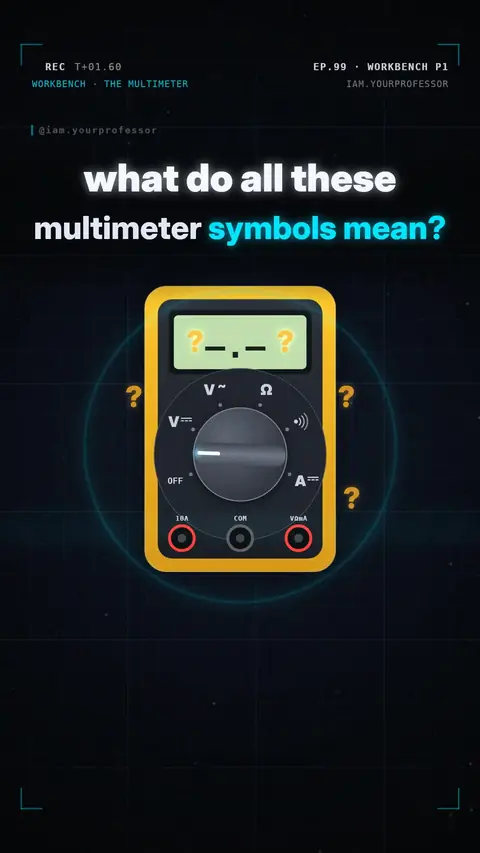
V with a straight line = DC volts, V with a wave = AC volts, Ω = resistance, A = current, the speaker = continuity beep, the diode symbol = diode test.
Got a multimeter but no idea what the symbols mean? 🤔 Here's the whole dial in 20 seconds 👇
1️⃣ VOLTS: V with a straight line (⎓) = DC volts — batteries, USB, phone chargers. V with a wave (~) = AC volts — the wall socket (230 V · 50 Hz in India, UK, Europe · 120 V · 60 Hz in the USA, Canada). ⚠️ Only measure mains if you are trained — practise on batteries.
2️⃣ OHMS + BEEP: Ω = resistance, in ohms (measure with the power OFF). The beep (continuity) checks if a wire or fuse is connected — beep = connected.
3️⃣ AMPS + SOCKETS: A = current, in amps. Black probe always in COM, red in V (VΩmA). Big currents need the separate, fused 10A socket — and the meter goes in series (coming in Part 6).
Volts, ohms, beep, amps!
Read the voiceover (transcript)
- What do all these multimeter symbols mean?
- V with a straight line is DC, like a battery. V with a wave is AC, like the wall socket.
- Omega means resistance, in ohms. The beep checks if a wire is connected.
- A means current, in amps. Black probe in COM, red in V. Amps need their own socket!
- Volts, ohms, beep, amps!
- Next: is your battery dead? Follow for Part two!
Related lessons
Get new lessons + early access to the full course
One email when new lessons drop. No spam, unsubscribe any time.
✓ You're on the list! We'll email you when new lessons drop.
By joining you agree to the privacy policy.