Ohm's Law Explained Simply: V = I × R With Real Examples
Ohm's law in plain English: V = I × R, the triangle trick, power P = V × I, and real examples with LEDs, chargers and heaters. Free calculator.
ON THIS PAGE
- Free Ohm's law calculator
- Voltage, current and resistance — the water picture
- The Ohm's law triangle
- Worked examples
- 1. How much current flows?
- 2. What resistor do I need?
- 3. What voltage do I get?
- 4. Why wet skin is more dangerous
- Power: the second formula you need
- Where Ohm's law does NOT work simply
- Frequently asked questions
Ohm's law is the one formula every electronics project uses. It connects the three things you meet in every circuit — voltage, current and resistance — and once it clicks, you can predict what any simple circuit will do before you even switch it on.
Free Ohm's law calculator
Slide the voltage and the resistance and watch the current and the power (heat) change live:
⚡ LOADING THE CALCULATOR…
Free, no sign-up. Prefer a bigger screen? Open the Ohm's law playground calculator in the Lab →
Voltage, current and resistance — the water picture
Imagine water in a pipe:
- Voltage (V, volts) is the push — like water pressure. A battery or a charger provides it.
- Current (I, amps) is the flow — how much charge moves past a point every second.
- Resistance (R, ohms, Ω) is how much the path resists the flow — like a narrow pipe.
More push → more flow. Narrower pipe → less flow. That is all Ohm's law says, in numbers.
The Ohm's law triangle
Draw a triangle with V on top and I × R on the bottom. Cover the one you want:
- Cover V → you see I × R → V = I × R
- Cover I → you see V over R → I = V ÷ R
- Cover R → you see V over I → R = V ÷ I
Worked examples
1. How much current flows?
A 5 V Arduino pin drives a 1 kΩ resistor to ground: I = 5 ÷ 1,000 = 0.005 A = 5 mA.
2. What resistor do I need?
An LED needs 15 mA, and 3 V must be dropped across the resistor: R = 3 ÷ 0.015 = 200 Ω → use 220 Ω. (Full method: LED resistor guide.)
3. What voltage do I get?
20 mA through a 470 Ω resistor: V = 0.02 × 470 = 9.4 V across it.
4. Why wet skin is more dangerous
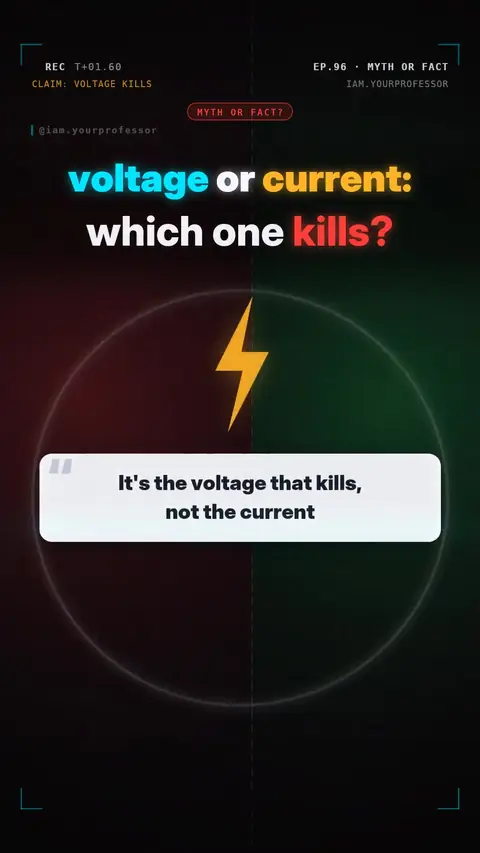
Dry skin can be roughly 100,000 Ω; wet skin can drop to around 1,000 Ω. At 230 V: dry ≈ 2.3 mA, wet ≈ 230 mA — far above the ≈ 30 mA that RCD/RCCB safety switches are designed to trip at. Same voltage, much lower resistance, much more current. (Real body resistance varies a lot — never test it.)
Power: the second formula you need
Current through a resistance makes heat. Power (watts) tells you how much:
- A 12 V, 2 A car device: P = 12 × 2 = 24 W.
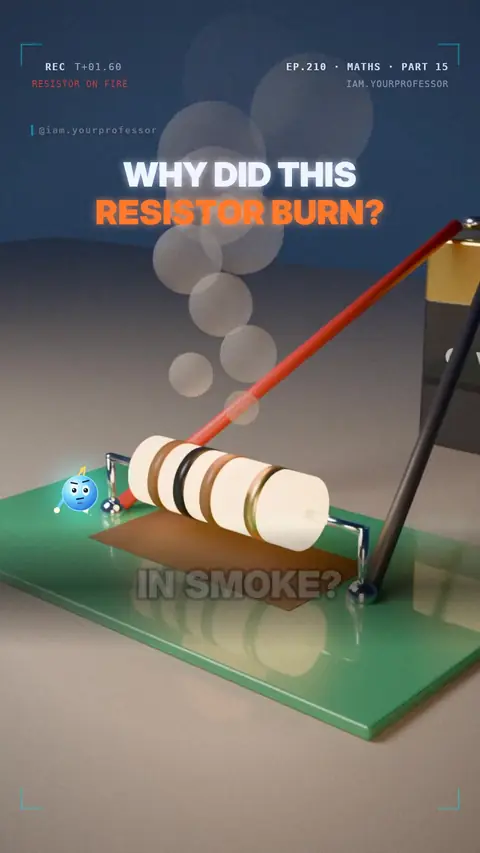
- 0.1 A through 100 Ω: P = 0.1² × 100 = 1 W → a small ¼ W resistor would burn.
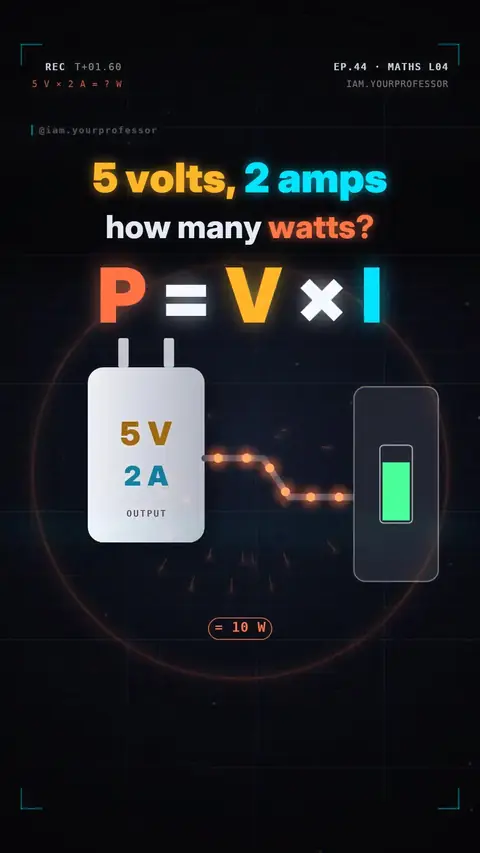
- Phone charger: 5 V × 2 A = 10 W; 9 V × 2.22 A ≈ 20 W fast charging.
Notice I²: double the current and the heat goes up four times. That is why power lines use very high voltage and low current, and why thin cables get hot.
Where Ohm's law does NOT work simply
Ohm's law is exact for resistors and wires. Some parts don't have a fixed resistance:
- LEDs and diodes: current rises very steeply once they turn on — that's why they need a series resistor.
- Filament bulbs: cold resistance is about 10× lower than hot resistance.
- Motors: they pull a big starting current, then less once spinning.
For these, use Ohm's law on the resistor around them, not on the part itself.
Frequently asked questions
What is Ohm's law in simple words?
The current through a resistor equals the voltage across it divided by its resistance. More voltage means more current; more resistance means less current.
What is the formula for Ohm's law?
V = I × R, which can be rearranged to I = V ÷ R and R = V ÷ I.
What are the units in Ohm's law?
Voltage in volts (V), current in amperes (A) and resistance in ohms (Ω).
How do you calculate power from voltage and current?
Multiply them: P = V × I. With resistance you can also use P = I² × R or P = V² ÷ R.
Does Ohm's law apply to LEDs?
Not directly, because an LED's resistance changes with current. Use Ohm's law on the series resistor: R = (supply voltage − LED voltage) ÷ current.