Resistor Color Code Chart: How to Read 4-Band and 5-Band Resistors
Read any resistor in seconds: color code chart for 4-band and 5-band resistors, digits, multiplier, tolerance, worked examples and a free decoder.
ON THIS PAGE
Resistors are too small to print a number on, so they wear coloured stripes instead. Once you know the code, you can read any resistor in about three seconds — no meter needed.
Resistor color code chart
| Colour | Digit | Multiplier | Tolerance |
|---|---|---|---|
| Black | 0 | × 1 | — |
| Brown | 1 | × 10 | ±1 % |
| Red | 2 | × 100 | ±2 % |
| Orange | 3 | × 1,000 (1 k) | — |
| Yellow | 4 | × 10,000 (10 k) | — |
| Green | 5 | × 100,000 (100 k) | ±0.5 % |
| Blue | 6 | × 1,000,000 (1 M) | ±0.25 % |
| Violet | 7 | × 10 M | ±0.1 % |
| Grey | 8 | × 100 M | ±0.05 % |
| White | 9 | × 1 G | — |
| Gold | — | × 0.1 | ±5 % |
| Silver | — | × 0.01 | ±10 % |
Free resistor color code decoder
Tap the bands and read the value — then try the decode challenge to test yourself.
⚡ LOADING THE CALCULATOR…
Free, no sign-up. Prefer a bigger screen? Open the Resistor colour code calculator in the Lab →
How to read a 4-band resistor
- Find the start. Hold the resistor so the gold or silver band is on the right. That band is the tolerance; the reading starts from the other end.
- Band 1 → first digit.
- Band 2 → second digit.
- Band 3 → multiplier (add that many zeros).
- Band 4 → tolerance.
Worked examples (4-band)
| Bands | Digits | Multiplier | Value |
|---|---|---|---|
| Red, red, brown, gold | 2, 2 | × 10 | 220 Ω ±5 % |
| Yellow, violet, brown, gold | 4, 7 | × 10 | 470 Ω ±5 % |
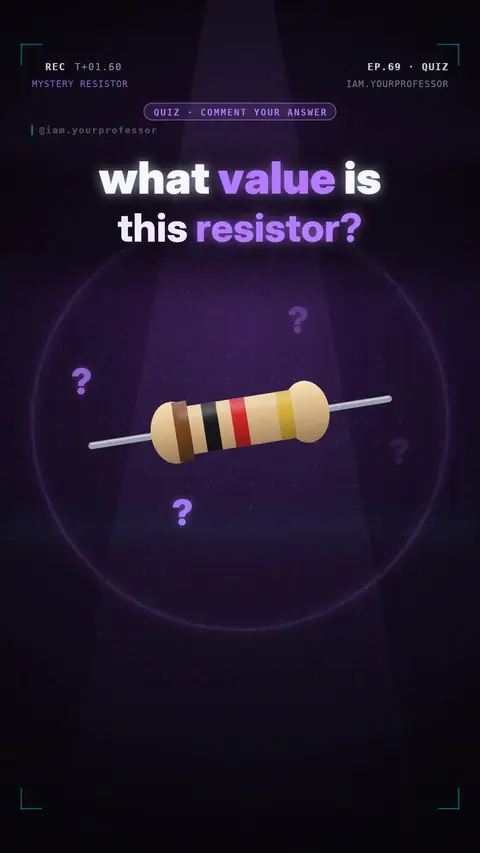
| Brown, black, red, gold | 1, 0 | × 100 | 1 kΩ ±5 % |
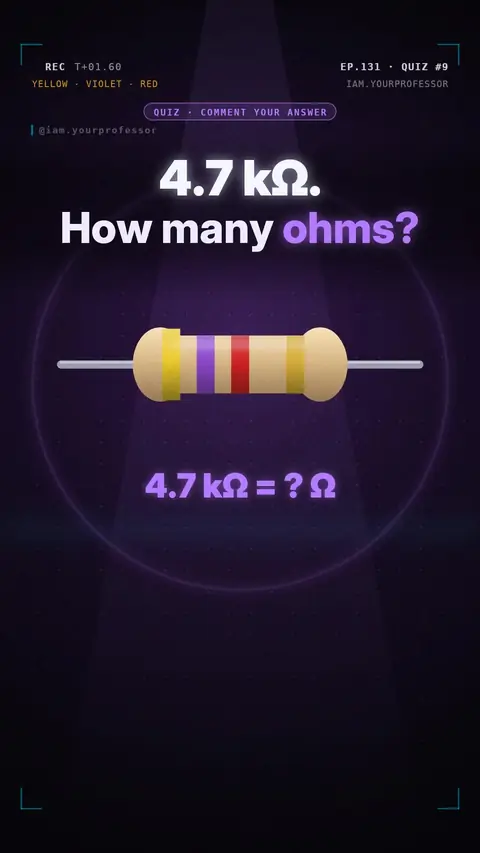
| Yellow, violet, red, gold | 4, 7 | × 100 | 4.7 kΩ ±5 % |
| Brown, black, orange, gold | 1, 0 | × 1,000 | 10 kΩ ±5 % |
| Brown, black, yellow, gold | 1, 0 | × 10,000 | 100 kΩ ±5 % |
| Brown, black, green, gold | 1, 0 | × 100,000 | 1 MΩ ±5 % |
How to read a 5-band resistor
Precision resistors (usually ±1 %, blue body) have three digit bands, then the multiplier, then the tolerance:
- Brown, black, black, brown, brown = 1, 0, 0 × 10 = 1 kΩ ±1 %
- Brown, black, black, red, brown = 1, 0, 0 × 100 = 10 kΩ ±1 %
- Red, red, black, black, brown = 2, 2, 0 × 1 = 220 Ω ±1 %
What does tolerance mean?
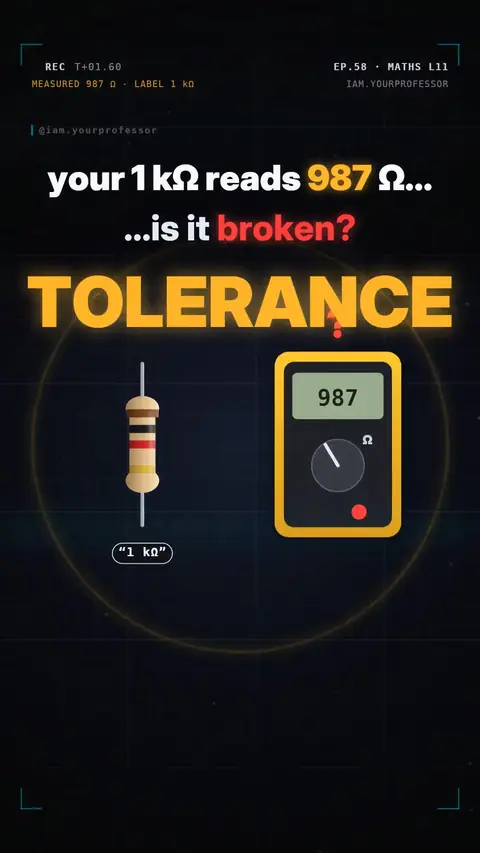
A 1 kΩ ±5 % resistor can be anywhere from 950 Ω to 1,050 Ω and still be "correct". For LEDs, pull-ups and most hobby circuits, ±5 % is perfect. Precision dividers and measurement circuits use ±1 % or better.
Common mistakes
- Reading from the wrong end → always put gold/silver on the right.
- Brown vs red vs orange under yellow light → use daylight or a phone torch.
- Violet vs blue, grey vs white on old resistors → when in doubt, measure it with a multimeter on the Ω range (with the resistor out of the circuit).
Standard resistor values (E12)
Resistors come in standard steps. In each decade, the E12 series is: 10, 12, 15, 18, 22, 27, 33, 39, 47, 56, 68, 82 (and ×10, ×100, ×1,000 …). That is why you buy a 220 Ω or 470 Ω resistor — never a 200 Ω or 500 Ω one in a basic kit.
Frequently asked questions
What is the color code for a 10k resistor?
Brown, black, orange, gold for a 4-band 10 kΩ ±5 % resistor. A 5-band 10 kΩ ±1 % resistor is brown, black, black, red, brown.
What is the color code for a 220 ohm resistor?
Red, red, brown, gold (4-band). On a 5-band resistor: red, red, black, black, brown.
What is the color code for a 1k resistor?
Brown, black, red, gold (4-band), or brown, black, black, brown, brown (5-band, ±1 %).
Which side do you start reading a resistor from?
Put the gold or silver tolerance band on the right and read from the left. On 5-band resistors the tolerance band has a slightly bigger gap before it.
What does a gold band mean on a resistor?
As the last band, gold means ±5 % tolerance. As the third band (multiplier), gold means × 0.1, for example yellow-violet-gold = 4.7 Ω.