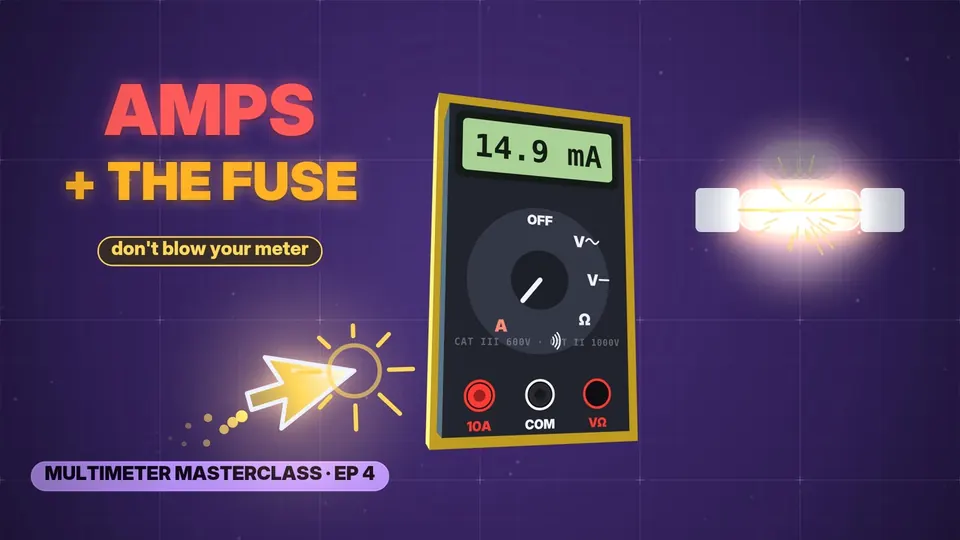
Multimeter Masterclass · EPISODE 4 · 2:39
Measure Current + the Fuse That Saves You
Why does current need the meter IN the circuit, and why do so many meters blow their fuse? Learn how to measure amps safely: break the loop, the right hole (mA or 10 A), the dial, a real reading, and the fuse that saves your meter. For beginners, in under 3 minutes. The finale of the Multimeter Masterclass.
// CHAPTERS · TAP TO JUMP
// IN THIS EPISODE
What you'll learn
- Voltage is measured ACROSS a part; current has to flow THROUGH the meter. Open the circuit and let the meter close the gap (in series), like a water meter cut into a pipe.
- Power off first. Black lead → COM. Red lead → mA for small currents, 10 A for big ones. Not sure? Start at 10 A, then move down.
- Dial to A with the straight line (DC). Then power on.
- Example: 9 V battery + 470 Ω + red LED → the meter reads ≈ 15 mA. Ohm's law agrees: (9 V − 2 V) ÷ 470 Ω ≈ 15 mA. Pull one probe off and the LED goes dark — the meter is part of the loop.
- Inside, the amps path is almost a plain wire (≈ 0.01 Ω). Put it straight across a battery = a short circuit, a huge current.
- The fuse is a thin wire that melts in a split second and opens the path. Meter stuck on 0 A? Take the fuse out and test it with the continuity beep: silence = blown.
- Replace it with the exact same rating (amps AND volts). Never a bigger one, never a piece of wire.
- Golden rule: after measuring current, move the red lead straight back to VΩ.
// 30-SECOND SHORTS ON THIS
Quick refreshers
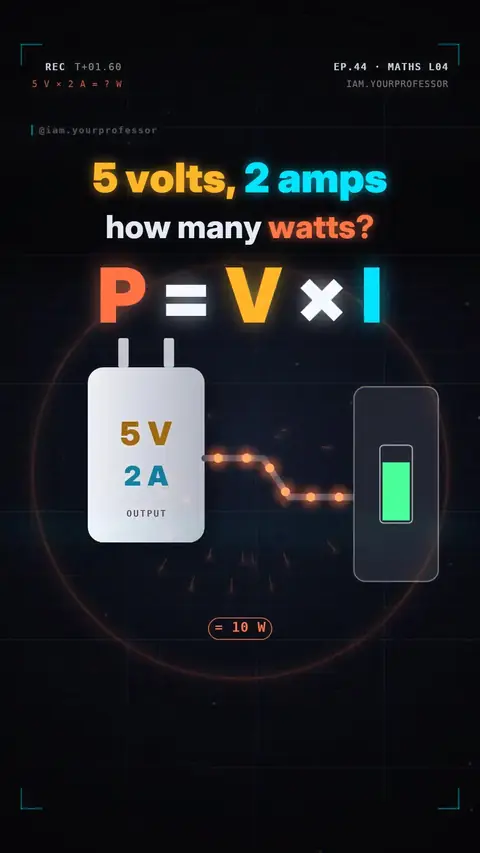 EP.44 · Maths for Electronics · 4Power: P = V × I
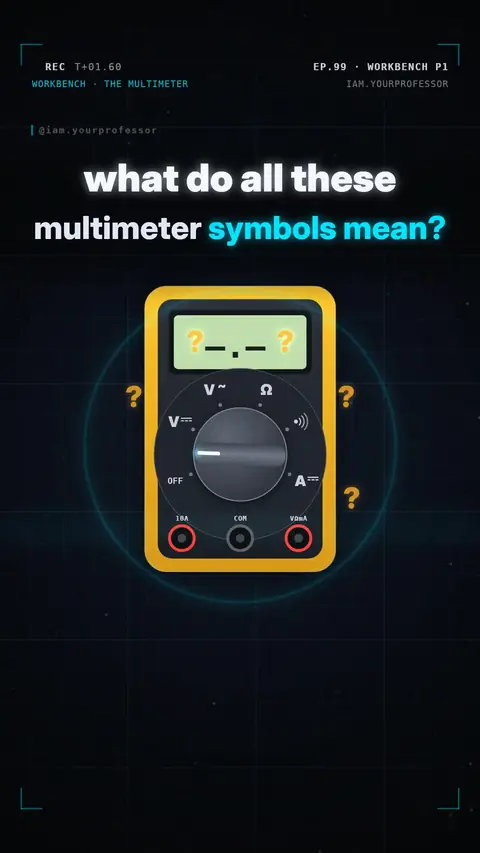 EP.99 · Workbench Skills · 1Workbench Skills Part 1: Meet the multimeter — every symbol on the dial
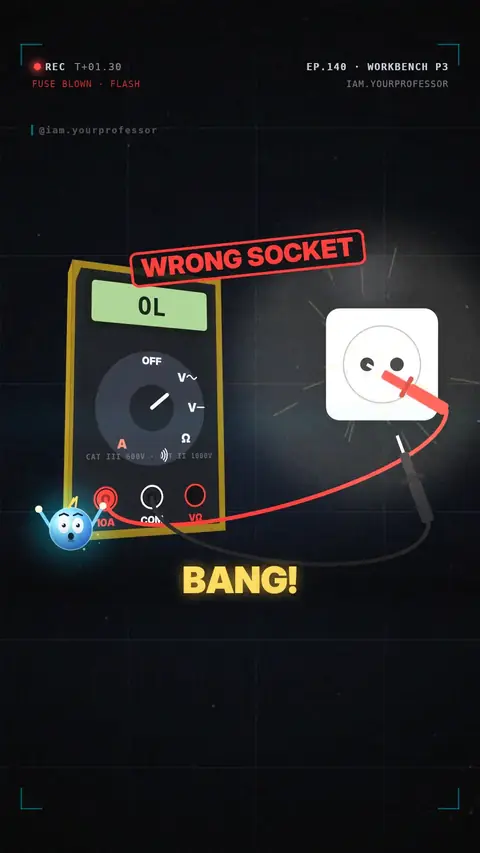 EP.140 · Workbench Skills · 3Workbench Skills Part 3: Measure mains voltage safely
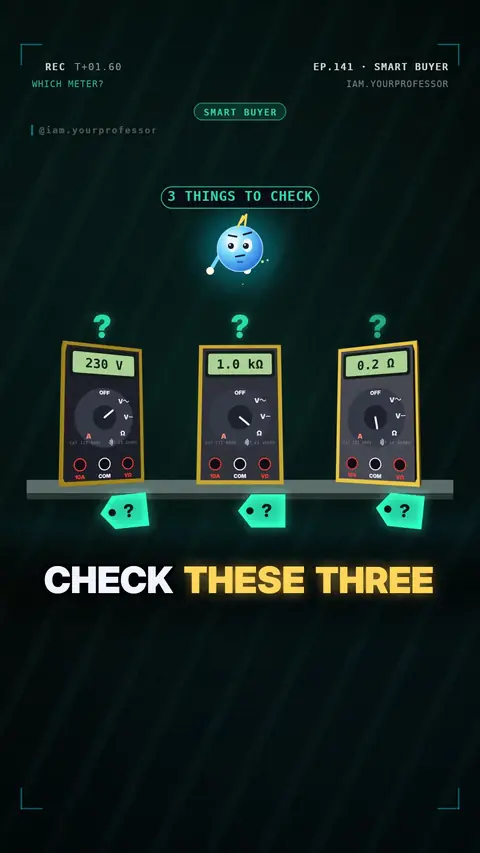 EP.141 · Smart BuyerSmart Buyer #6: Your first multimeter — 3 things to check
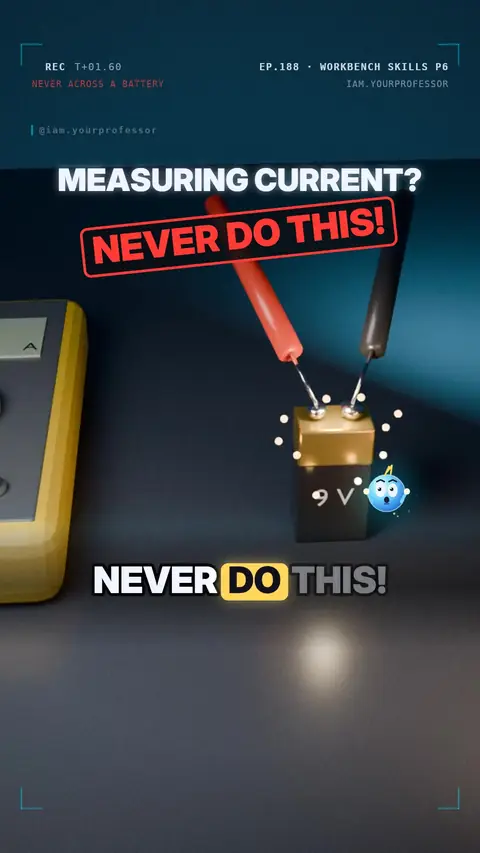 EP.188 · Workbench Skills · 6Workbench Skills Part 6: Measure current — the meter goes IN the circuit
// NEWSLETTER · FREE
Get the next episode first
One email when a new episode drops. No spam.
✓ You're on the list! We'll email you when new lessons drop.
By joining you agree to the privacy policy.