// FREE COURSE A · Total beginner
Electronics from Zero
6 stand-alone episodes for total beginners: voltage, current, resistance → Ohm's law → first circuit → series vs parallel → capacitors → the transistor switch.
6/6 episodes out17 min6 on YouTube0 cost
// EPISODES
Watch in order
Each episode stands alone, but they build on each other.
012:55
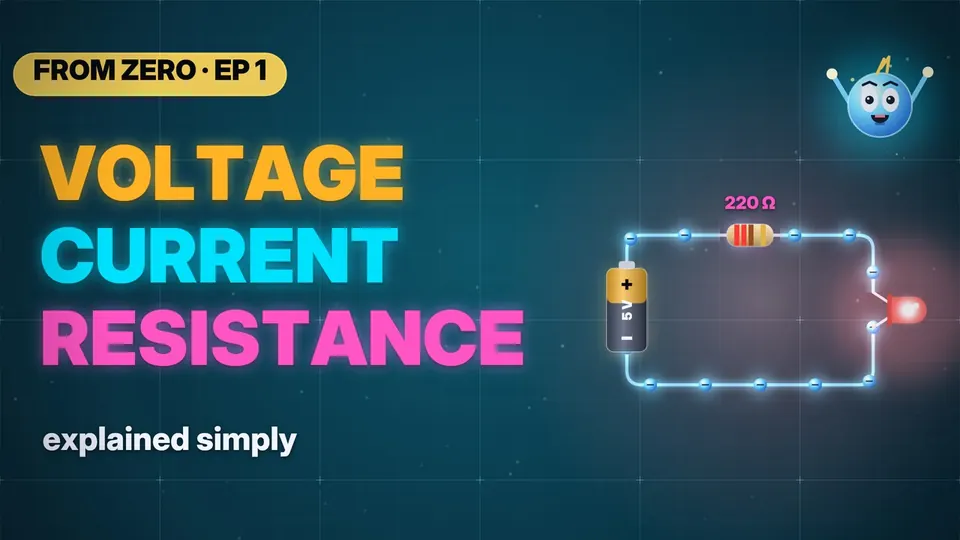
Voltage, Current and ResistanceVoltage is the push (volts), current is the flow (amps), resistance fights the flow (ohms) — and why an LED needs a resistor.▶ Watch now
02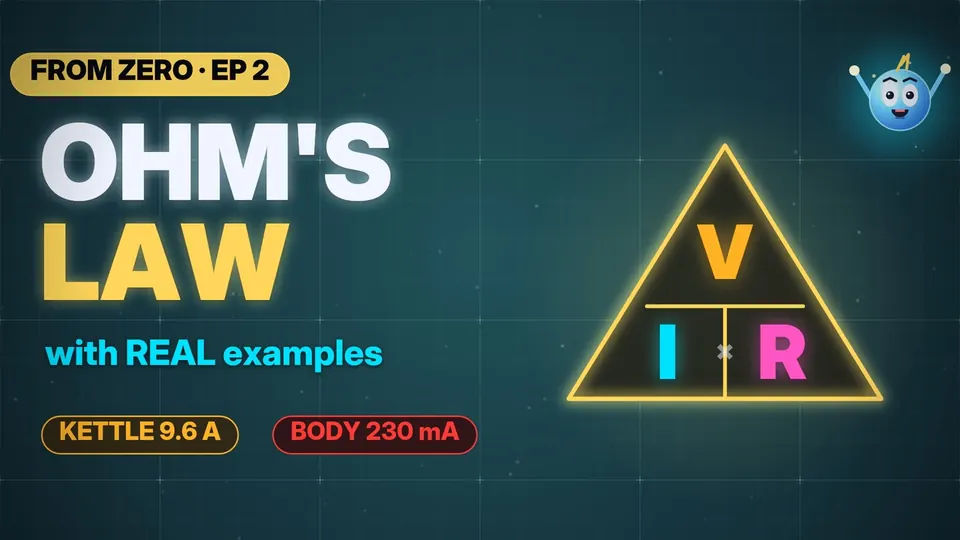 2:52
Ohm's Law with Real ExamplesV = I × R on real things: double the voltage → double the current, the triangle trick, a kettle, your body (dry vs wet skin), a toaster and a phone cable.▶ Watch now
03
 2:49
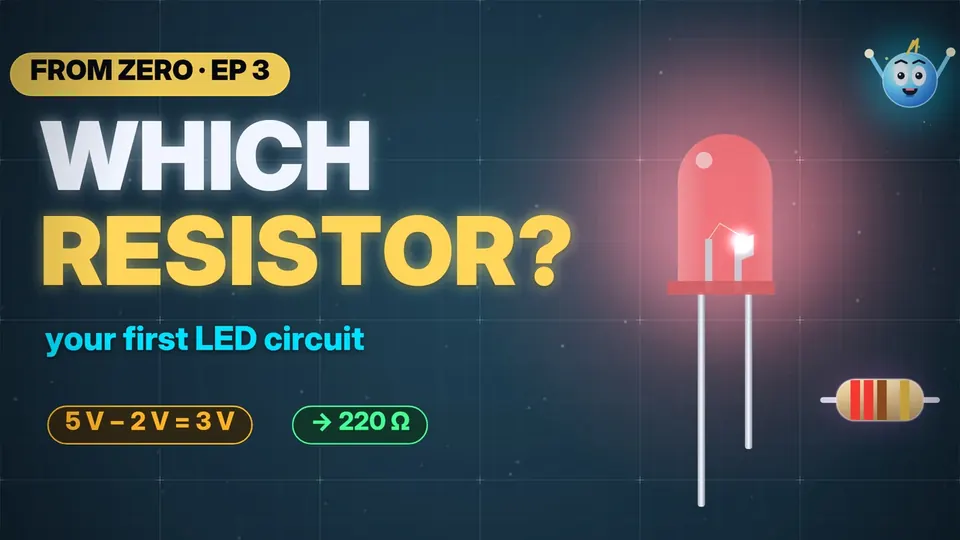
Your First Circuit, an LED + the Right ResistorMeet the LED (legs, one-way, 2 V / 3 V slice, 20 mA), then the 3-step recipe: supply − LED voltage, ÷ current, next size up (5 V red LED → 220 Ω; 9 V → 470 Ω; white on 5 V → 150 Ω).▶ Watch now
04
 2:58
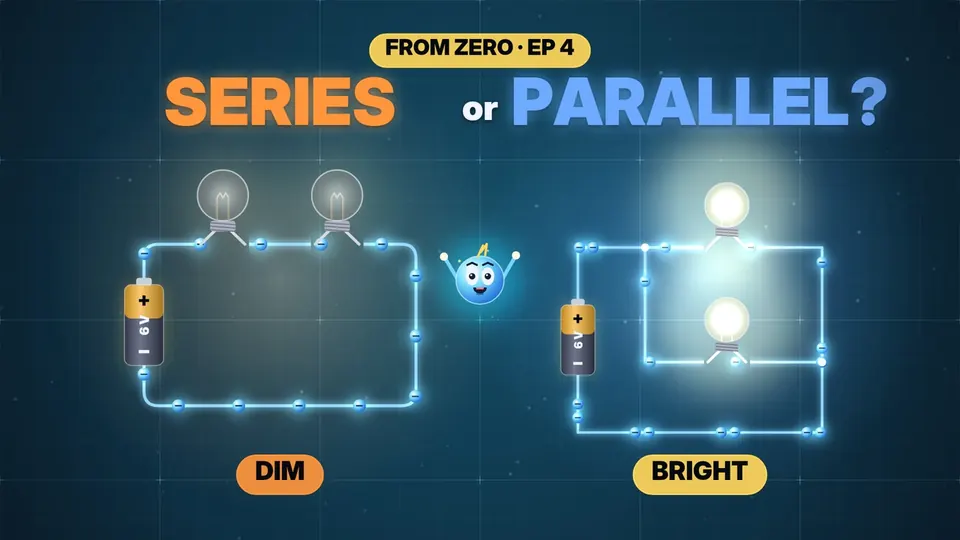
Series vs ParallelSeries = one path: same current, the voltage is shared, one breaks → all dark, resistors add. Parallel = own paths: full voltage each, currents add, one breaks → the rest stay on (your home), and more resistors = less resistance (two equal → half). Test: two 1 kΩ on 6 V → 3 mA vs 12 mA.▶ Watch now
05
 2:55
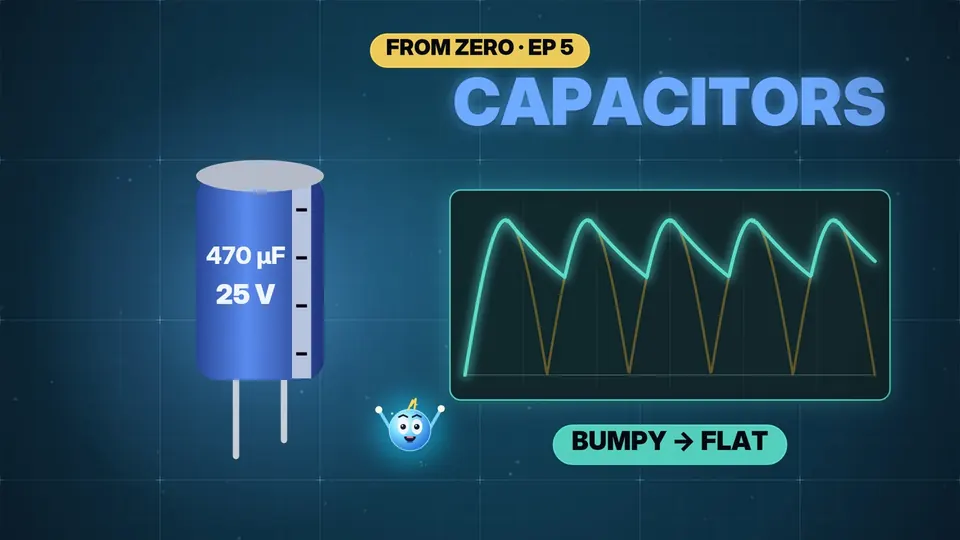
Capacitors — Store, Smooth, TimeA capacitor stores charge on two plates, smooths bumpy DC into a flat line, and with a resistor keeps time (τ = R × C).▶ Watch now
06
 2:46
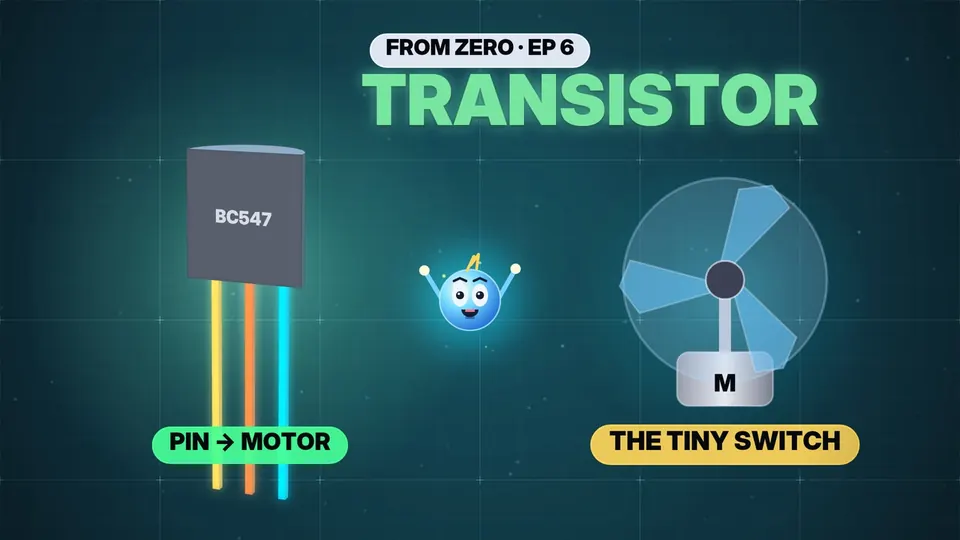
The Transistor as a Switch (series finale)A tiny base current lets a ~100× bigger current flow (the water tap): wire a pin → 1 kΩ → base, motor on the collector, emitter to ground; pin high = on, pin low = off, switch fully (half on = hot), a diode across the motor — and billions of these switches make every computer.▶ Watch now
2:55
Voltage, Current and ResistanceVoltage is the push (volts), current is the flow (amps), resistance fights the flow (ohms) — and why an LED needs a resistor.▶ Watch now
022:52
Ohm's Law with Real ExamplesV = I × R on real things: double the voltage → double the current, the triangle trick, a kettle, your body (dry vs wet skin), a toaster and a phone cable.▶ Watch now
032:49
Your First Circuit, an LED + the Right ResistorMeet the LED (legs, one-way, 2 V / 3 V slice, 20 mA), then the 3-step recipe: supply − LED voltage, ÷ current, next size up (5 V red LED → 220 Ω; 9 V → 470 Ω; white on 5 V → 150 Ω).▶ Watch now
042:58
Series vs ParallelSeries = one path: same current, the voltage is shared, one breaks → all dark, resistors add. Parallel = own paths: full voltage each, currents add, one breaks → the rest stay on (your home), and more resistors = less resistance (two equal → half). Test: two 1 kΩ on 6 V → 3 mA vs 12 mA.▶ Watch now
052:55
Capacitors — Store, Smooth, TimeA capacitor stores charge on two plates, smooths bumpy DC into a flat line, and with a resistor keeps time (τ = R × C).▶ Watch now
062:46
The Transistor as a Switch (series finale)A tiny base current lets a ~100× bigger current flow (the water tap): wire a pin → 1 kΩ → base, motor on the collector, emitter to ground; pin high = on, pin low = off, switch fully (half on = hot), a diode across the motor — and billions of these switches make every computer.▶ Watch now
// NEWSLETTER · FREE
Get the next episode first
One email when a new episode drops. No spam.
✓ You're on the list! We'll email you when new lessons drop.
By joining you agree to the privacy policy.