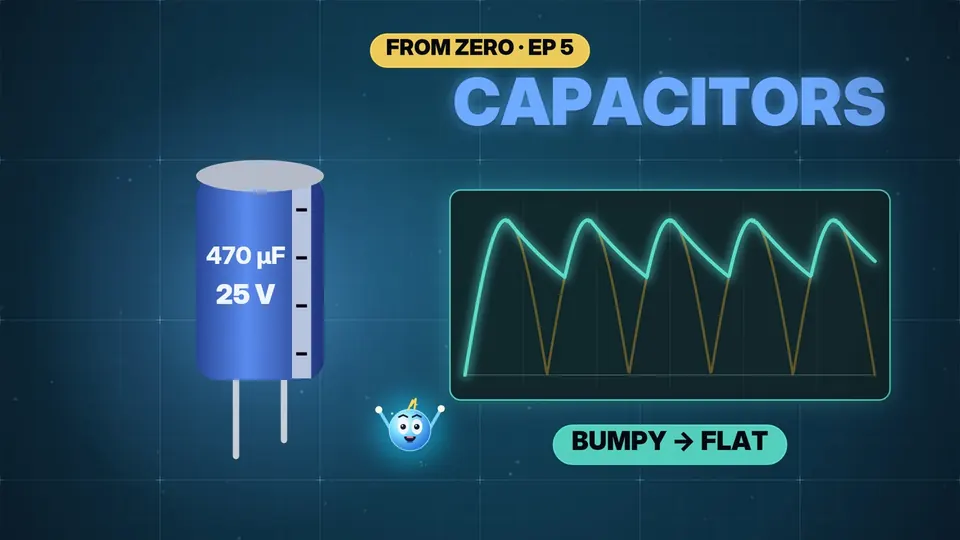
Electronics from Zero · EPISODE 5 · 2:55
Capacitors — Store, Smooth, Time
What is a capacitor, and why is it in almost every gadget you own? Two metal plates that never touch — and they can store energy, smooth bumpy power, and even keep time. Learn it in under 3 minutes.
// CHAPTERS · TAP TO JUMP
// IN THIS EPISODE
What you'll learn
- A capacitor = two metal plates with a thin insulator between them. A battery piles electrons onto one plate and pulls them off the other; they can't cross the gap, so the charge (and the energy) stays when the battery leaves.
- Battery = big tank, slow. Capacitor = small bucket that can empty in a split second (camera flash: a few seconds to charge, about a thousandth of a second to fire).
- Measured in farads (F); most are microfarads (µF, millionths of a farad) or nanofarads. Electrolytic ("can") capacitors: the stripe marks minus, the longer leg is plus, never go over the printed voltage.
- Smoothing: a charger turns AC into bumpy DC (100 bumps a second on 50 Hz mains, 120 on 60 Hz). The capacitor fills on every bump and gives energy back in every dip → an almost flat line. That's also why every chip has a 100 nF capacitor right next to its power pin.
- Timing: a resistor in front makes it fill slowly. Time constant τ = R × C. 10 kΩ × 100 µF = 1 second; after about 5 τ it's basically full (63 % after one τ). Used for blinking LEDs, delays and timers.
- Safety: big capacitors (TVs, microwaves, power supplies) can stay charged after unplugging. Never open them.
// 30-SECOND SHORTS ON THIS
Quick refreshers
 EP.07 · Capacitor Series · 1How a capacitor stores energy
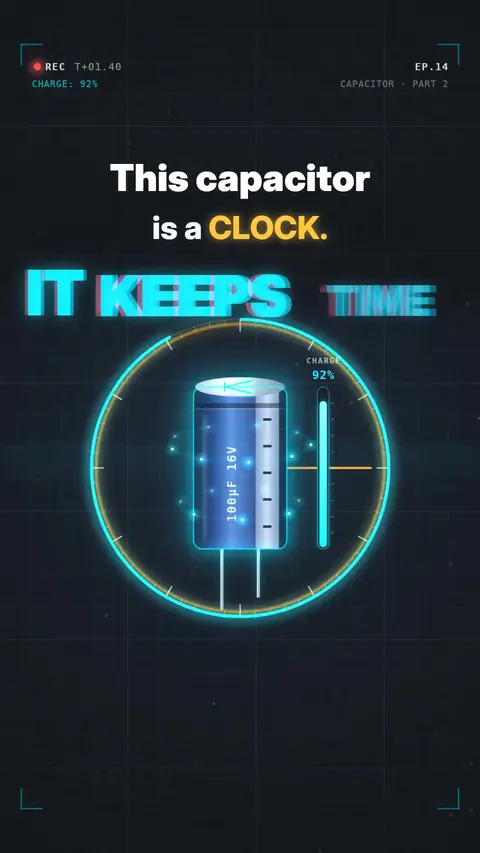 EP.14 · Capacitor Series · 2How a capacitor keeps TIME
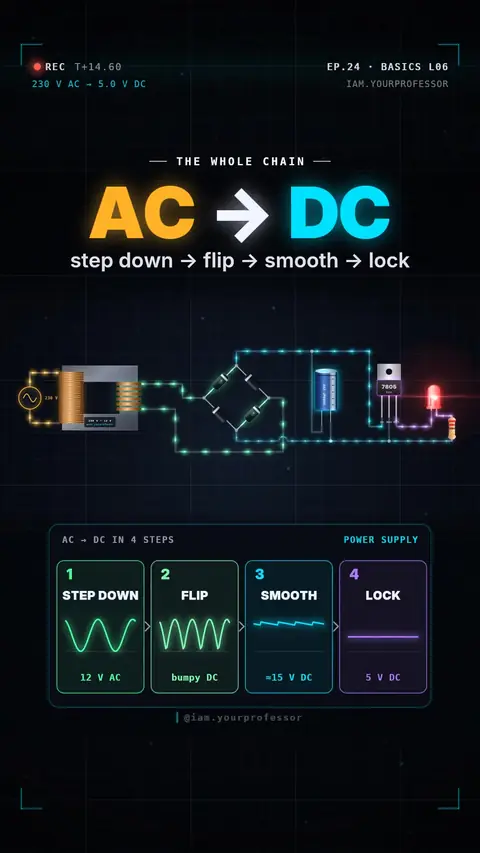 EP.24 · Electronics Basics · 6AC → DC: how a power supply makes DC
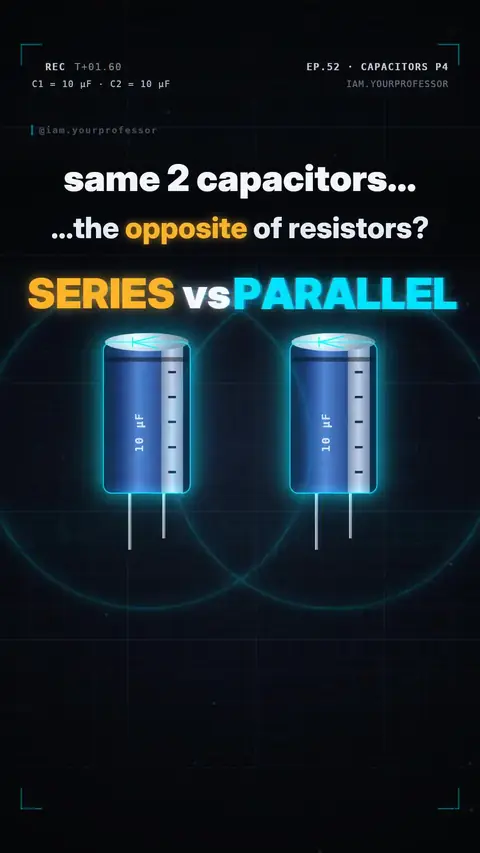 EP.52 · Capacitor Series · 4Capacitors in series vs parallel
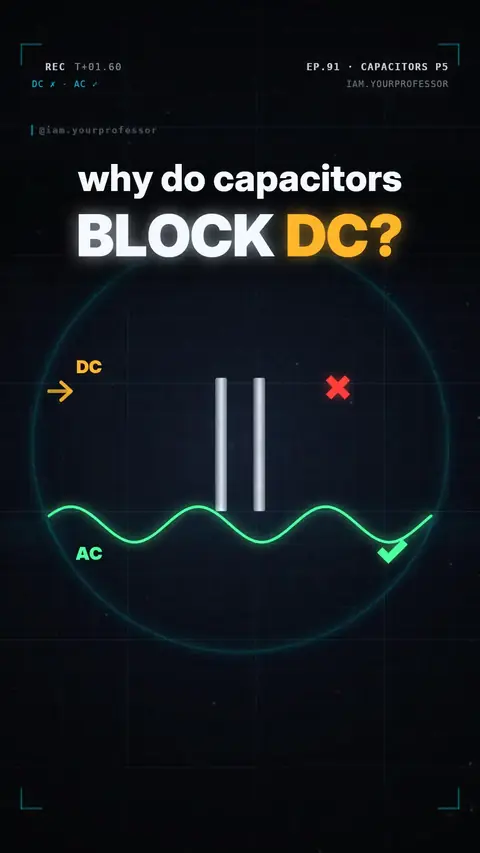 EP.91 · Capacitor Series · 5Why a capacitor blocks DC but passes AC
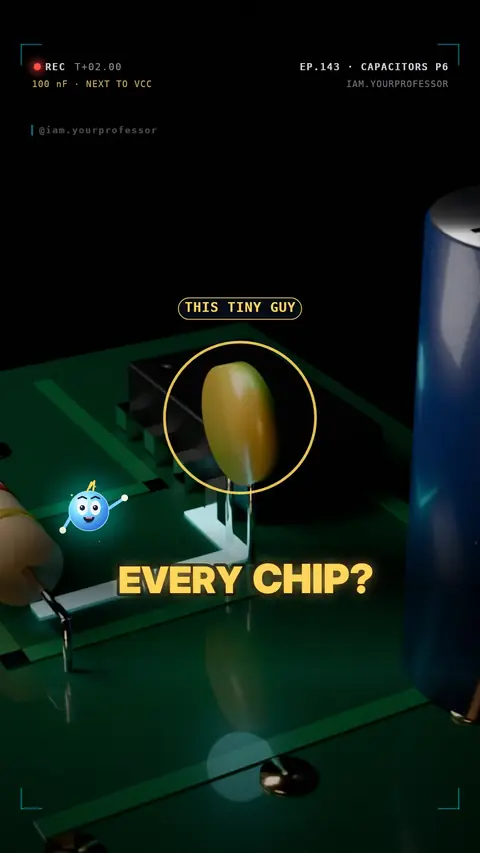 EP.143 · Capacitor Series · 6Capacitor Series Part 6: Decoupling caps — the tiny capacitor beside every chip
// NEWSLETTER · FREE
Get the next episode first
One email when a new episode drops. No spam.
✓ You're on the list! We'll email you when new lessons drop.
By joining you agree to the privacy policy.