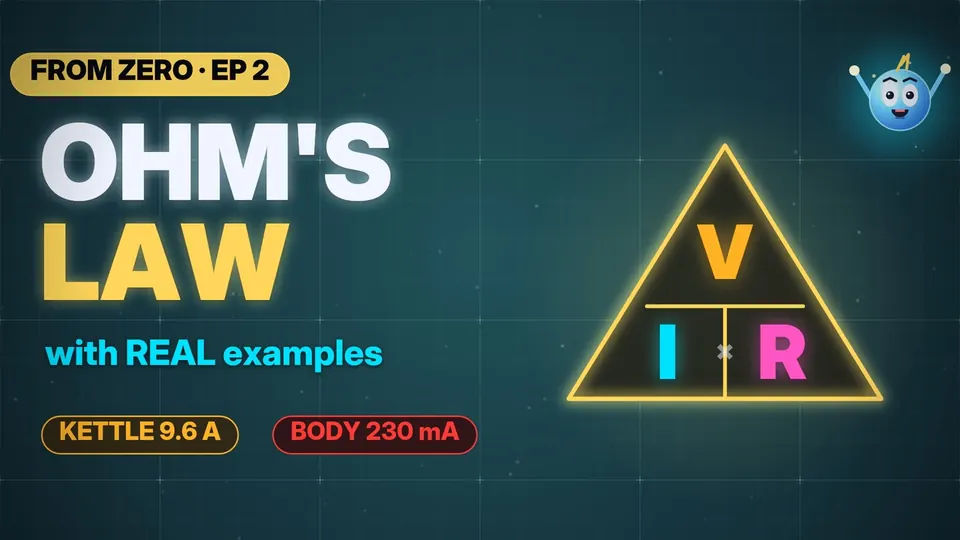
Electronics from Zero · EPISODE 2 · 2:52
Ohm's Law with Real Examples
One rule works in every circuit you will ever build: Ohm's law, V = I × R. Learn it in under 3 minutes with real examples — a kettle, a toaster, your phone cable and your own body (and why water and electricity never mix).
// CHAPTERS · TAP TO JUMP
// IN THIS EPISODE
What you'll learn
- Double the voltage → double the current (5 V + 220 Ω ≈ 23 mA, 10 V ≈ 45 mA). Double the resistance → half the current.
- Ohm's law: current = voltage ÷ resistance. Written V = I × R (I = current, from "intensity"). Georg Ohm, 1827.
- The triangle trick: cover the one you want. I = V ÷ R · R = V ÷ I · V = I × R.
- 9 V and 1,000 Ω → 9 mA. A kettle: 230 V ÷ 24 Ω ≈ 9.6 A (India, UK, Europe) · 120 V ÷ 10 Ω = 12 A (USA, Canada).
- Your body: dry skin ≈ 100,000 Ω → a 9 V battery pushes only 0.09 mA (you feel nothing). Wet skin ≈ 1,000 Ω → a wall socket pushes over 100 mA (230 mA at 230 V, 120 mA at 120 V) — enough to stop a heart. Never touch mains.
- A toaster on 120 V pulling 10 A → its heating wire is 12 Ω.
- A phone cable ≈ 0.2 Ω: 3 A × 0.2 Ω = 0.6 V lost as heat. A cheap, thin cable has more resistance → slower charging.
// 30-SECOND SHORTS ON THIS
Quick refreshers
 EP.09 · Electronics Basics · 1Why does a resistor resist current?
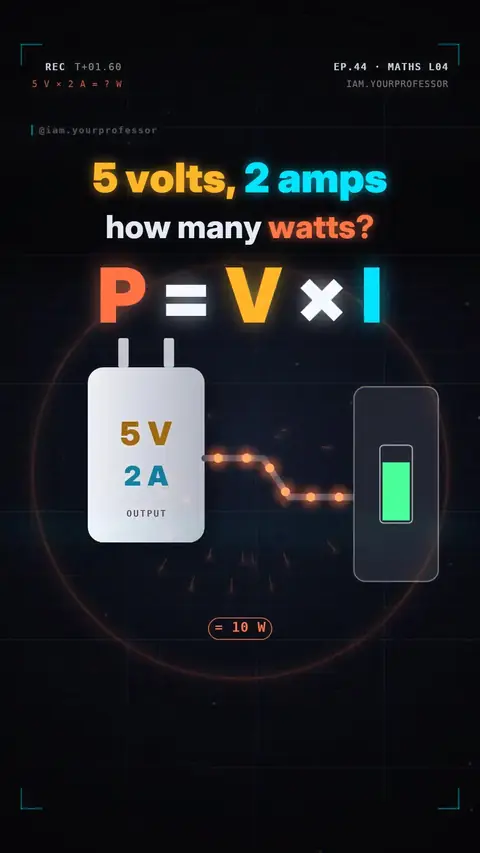 EP.44 · Maths for Electronics · 4Power: P = V × I
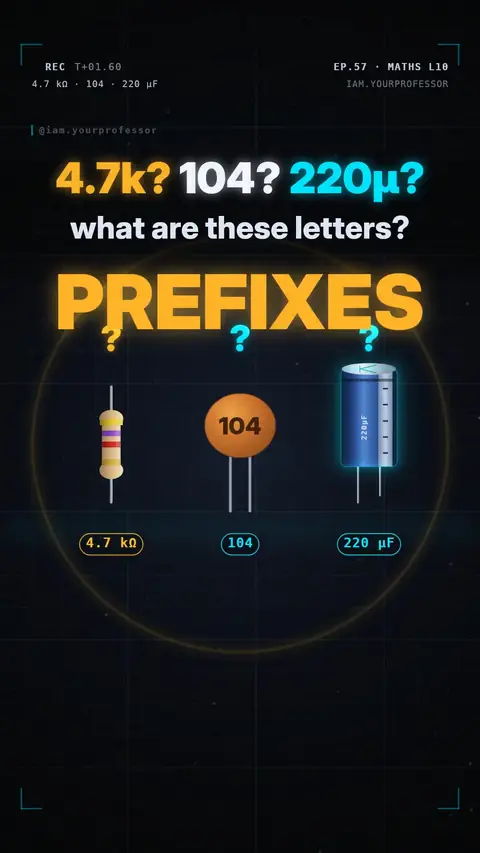 EP.57 · Maths for Electronics · 10Prefixes: kilo, milli, micro, nano
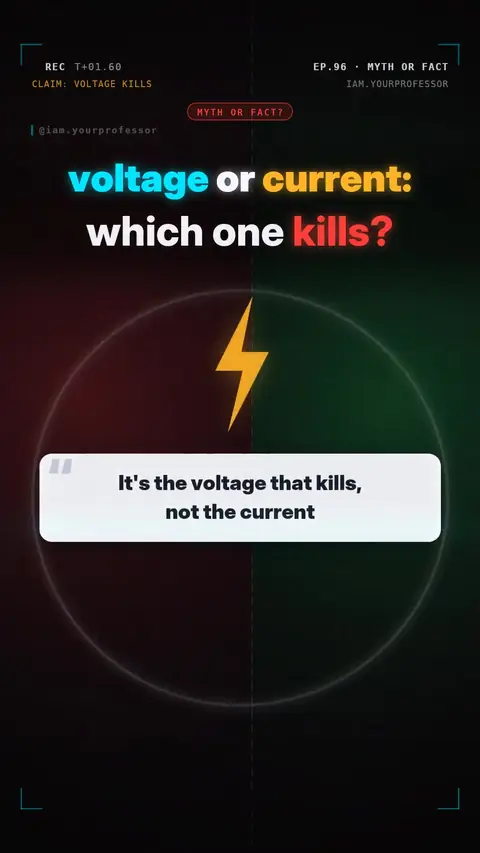 HALF TRUE
EP.96 · Myth or FactMyth or Fact: "It's the voltage that kills, not the current"
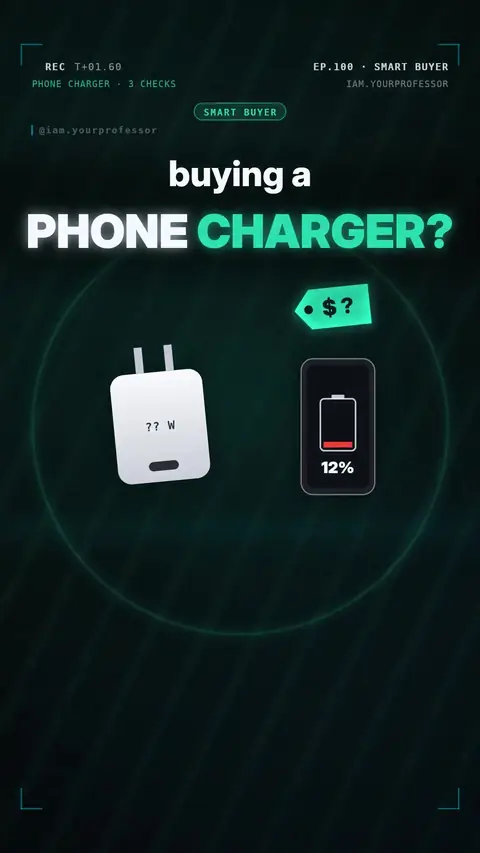 EP.100 · Smart BuyerSmart Buyer #4: Phone charger — watts, USB PD and why the cable matters
 MYTH
EP.104 · Myth or FactMyth or Fact #7: "Rubber slippers make you 100 % safe from shock"
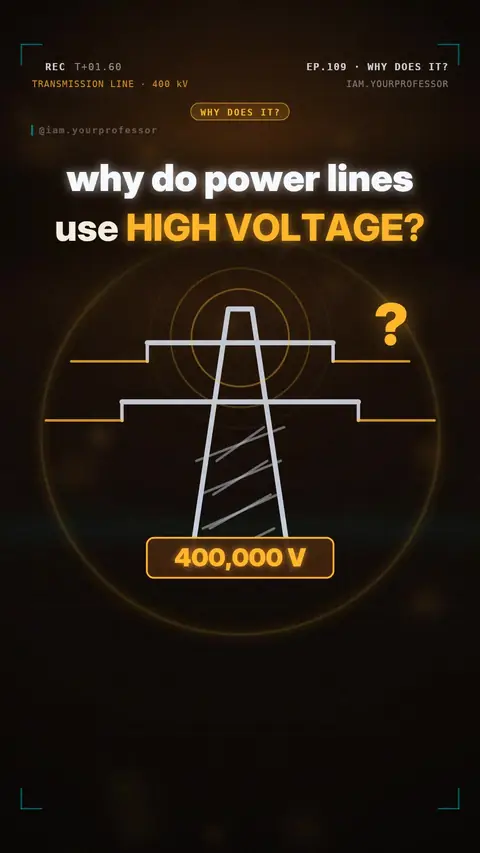 EP.109 · Why does…?Why does…? #8: Why do power lines use such high voltage?
// NEWSLETTER · FREE
Get the next episode first
One email when a new episode drops. No spam.
✓ You're on the list! We'll email you when new lessons drop.
By joining you agree to the privacy policy.