Why a capacitor blocks DC but passes AC
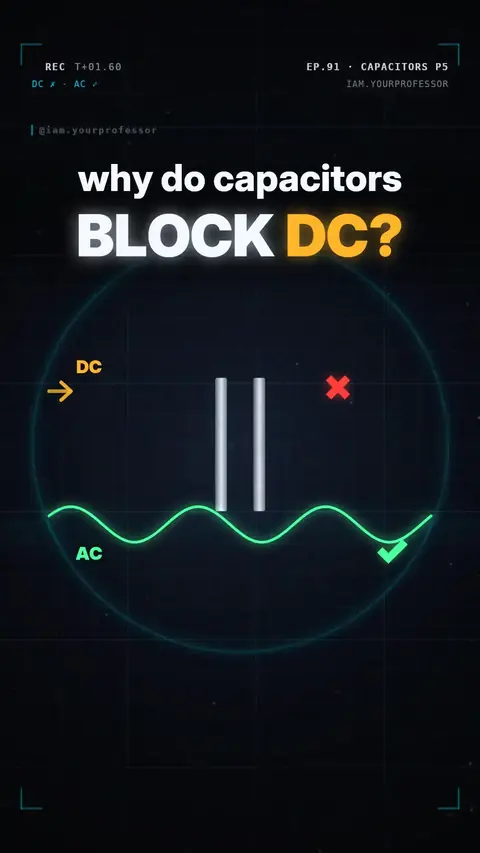
A capacitor charges up and stops DC, but AC keeps charging and discharging it, so AC gets through (more easily at higher frequency).
Why does a capacitor block DC but let AC through? ⚡
1️⃣ INSIDE: two metal plates with a gap (an insulator). No charge ever crosses that gap.
2️⃣ WITH DC: charge rushes onto the plates until they're full… then the current stops. The bulb flashes once and goes dark. DC = blocked.
3️⃣ WITH AC: the push keeps flipping back and forth, so the plates charge, discharge and charge the other way — again and again. Charge keeps moving in the wires, so the current keeps flowing. AC = passes!
🔊 Bonus: faster AC gets through even easier (Xc = 1 ÷ 2πfC). That's how a speaker sends the treble to the tweeter — one capacitor blocks the bass.
Read the voiceover (transcript)
- Why do capacitors block DC?
- Inside: two metal plates and a gap. With DC, the plates fill up, then current stops!
- But AC flips back and forth. The plates charge, discharge, again. Current flows!
- Faster AC gets through even easier. That's how a speaker sends treble to the tweeter!
- DC blocked, AC passes!
- Next: the cap beside every chip! Follow for Part six!
Related lessons
Get new lessons + early access to the full course
One email when new lessons drop. No spam, unsubscribe any time.
✓ You're on the list! We'll email you when new lessons drop.
By joining you agree to the privacy policy.