Maths for Electronics L15: why resistors burn — P = I² × R
// WHAT YOU WILL LEARN
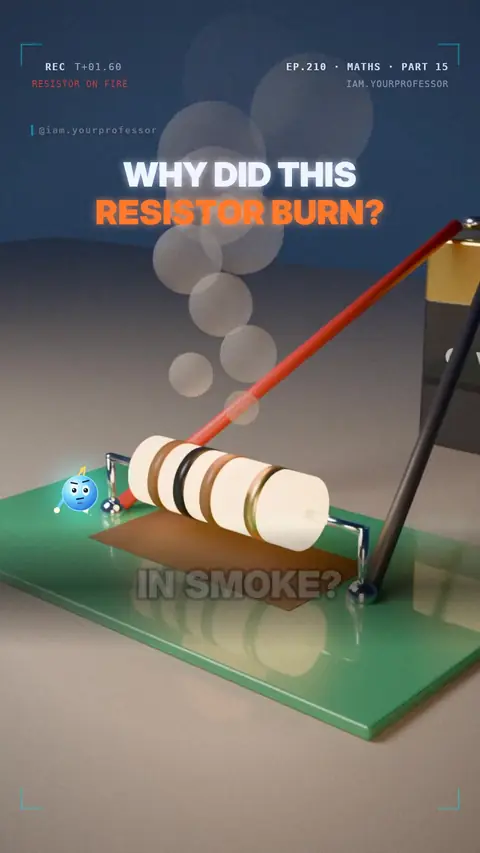
Power in a resistor = current squared × resistance; double the current = 4× the heat, so pick a resistor whose power rating (¼ W, ½ W…) is above it.
// LESSON NOTES
Why did this resistor go up in smoke? 🔥💨
🔢 Heat in a resistor: P = I² × R (power = current × current × resistance).
🧮 100 Ω with 50 mA (0.05 A): 0.05 × 0.05 × 100 = 0.25 W — a quarter watt.
⚠️ Double the current (100 mA) and the heat goes up FOUR times: 1 W! (The current is squared.)
🔥 On a ¼ W resistor that's 4× too much — it cooks.
✅ Rule of thumb: pick a power rating about twice the heat you expect (1 W → a 2 W resistor).
KEY FORMULA
P = I² × RRead the voiceover (transcript)
- Why did this resistor go up in smoke?
- Heat in a resistor: P equals I squared times R.
- One hundred ohms, fifty milliamps: a quarter watt.
- Double the current, and the heat goes up four times!
- Quarter-watt part. Now what?
- It cooks! Four times too much!
- Pick a rating twice the heat.
- Next: why long wires waste power. Follow for Part 16!
Related lessons
// NEWSLETTER · FREE
Get new lessons + early access to the full course
One email when new lessons drop. No spam, unsubscribe any time.
✓ You're on the list! We'll email you when new lessons drop.
By joining you agree to the privacy policy.