Series and Parallel Resistors: Formulas, Examples and Calculator
Resistors in series add up; in parallel the total gets smaller. Formulas, the two-resistor shortcut, worked examples and a free calculator.
ON THIS PAGE
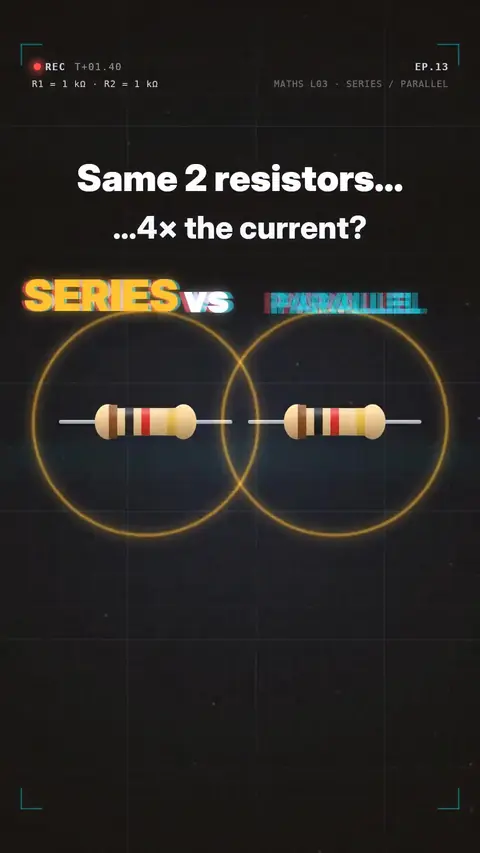
Don't have the exact resistor you need? Combine two. Resistors in series add up; resistors in parallel give a smaller total. These two rules also explain fairy lights, home wiring and why one dead bulb can kill a whole string.
Free series and parallel resistor calculator
Build a chain or a ladder of resistors and see the total change:
⚡ LOADING THE CALCULATOR…
Free, no sign-up. Prefer a bigger screen? Open the Series vs parallel calculator in the Lab →
Resistors in series
In series, the current has one path and must go through every resistor, so the resistances simply add:
- 220 Ω + 330 Ω = 550 Ω
- 1 kΩ + 2.2 kΩ + 4.7 kΩ = 7.9 kΩ
What happens in a series circuit:
- The current is the same everywhere.
- The voltage is shared: each resistor takes V = I × R (that's a voltage divider).
- If one part breaks, the path is open and everything stops — like old Christmas lights.
Resistors in parallel
In parallel, each resistor gives the current another path, so the total resistance goes down:
Shortcut for two resistors
- 1 kΩ ∥ 1 kΩ = 1,000,000 ÷ 2,000 = 500 Ω
- 1 kΩ ∥ 2.2 kΩ = 2,200,000 ÷ 3,200 ≈ 688 Ω
- 10 kΩ ∥ 100 Ω ≈ 99 Ω (the small one wins)
What happens in a parallel circuit:
- The voltage is the same across every branch.
- The currents add up: each branch takes I = V ÷ R.
- If one branch breaks, the others keep working — that's how your home is wired.
Series vs parallel at a glance
| Series | Parallel | |
|---|---|---|
| Paths for current | One | Several |
| Total resistance | Adds up (bigger) | Gets smaller |
| Current | Same everywhere | Splits between branches |
| Voltage | Shared between parts | Same across every branch |
| One part fails | Everything stops | Others keep working |
| Real example | Old fairy lights, battery cells for more volts | Home sockets and lights, car lights |
Practical uses
- Make a value you don't have: two 1 kΩ in series = 2 kΩ; in parallel = 500 Ω.
- Share the heat: four 100 Ω ¼ W resistors in a 2 × 2 series-parallel block = 100 Ω that handles about 1 W.
- Batteries: cells in series add volts (2 × 1.5 V = 3 V); in parallel they add capacity at the same voltage.
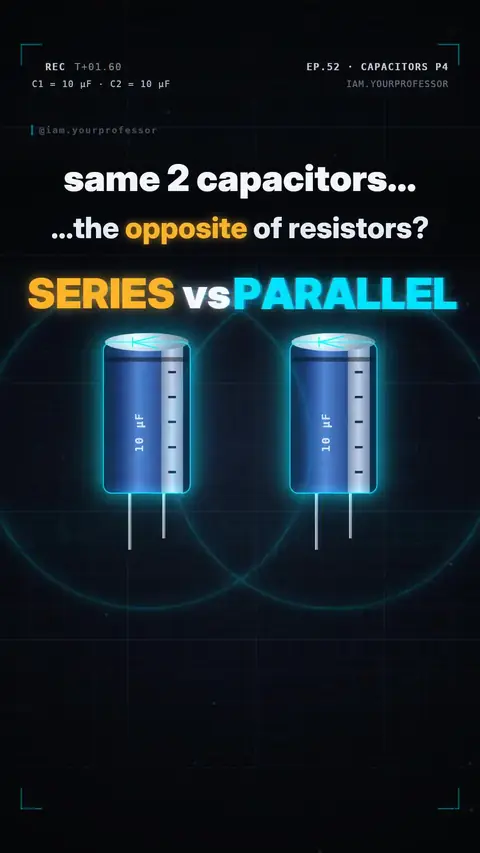
- Capacitors follow the opposite rules: in parallel they add, in series the total gets smaller.
Frequently asked questions
How do you calculate resistors in series?
Add them up: R = R1 + R2 + R3. A 100 Ω and a 220 Ω resistor in series make 320 Ω.
How do you calculate two resistors in parallel?
Multiply them and divide by their sum: R = (R1 × R2) ÷ (R1 + R2). Two 10 kΩ resistors in parallel make 5 kΩ.
Why does parallel resistance go down?
Each extra resistor is another path for the current, so more current flows for the same voltage — which means a lower total resistance.
Are houses wired in series or parallel?
In parallel, so every appliance gets the full mains voltage (230 V in India, the UK and Europe; 120 V in the USA and Canada) and keeps working when another one is switched off.