What Resistor Do I Need for an LED? (5 V, 12 V, 3.3 V, 9 V) + Calculator
Find the right LED resistor with R = (Vs − Vf) ÷ I. Ready values for 3.3 V, 5 V, 9 V and 12 V, resistor wattage, and a free LED resistor calculator.
ON THIS PAGE
Connect an LED straight to a battery and it flashes bright for a moment — then it's dead. An LED has almost no resistance once it turns on, so it needs a resistor in series to limit the current. Here is how to pick the right one in under a minute.
Free LED resistor calculator
Pick your supply, your LED colour and the current. It picks the standard resistor for you and checks the resistor's heat.
⚡ LOADING THE CALCULATOR…
Free, no sign-up. Prefer a bigger screen? Open the LED resistor designer calculator in the Lab →
The LED resistor formula
Step 1: the LED's forward voltage (Vf)
Each colour needs a different voltage to light up. Typical values for standard 5 mm LEDs (always check your datasheet):
| LED colour | Typical forward voltage |
|---|---|
| Red | 1.8–2.2 V |
| Orange / yellow | 2.0–2.2 V |
| Green (yellow-green) | 2.0–2.4 V |
| Green (true green), blue, white | 2.8–3.4 V |
| Infrared | 1.2–1.5 V |
Step 2: pick the current
Most standard 5 mm LEDs are rated 20 mA maximum. 10–15 mA is bright enough and makes them last longer. For indicator LEDs, even 2–5 mA is visible.
Step 3: calculate and round up
Calculate R, then pick the next standard value up (E12: 100, 120, 150, 180, 220, 270, 330, 390, 470, 560, 680, 820 Ω …). Rounding up means slightly less current, which is always safe.
Ready-made LED resistor values
At about 15 mA, rounded up to a standard value:
| Supply | Red / yellow (≈ 2 V) | Blue / white (≈ 3.2 V) |
|---|---|---|
| 3.3 V (ESP32, Pico) | 100 Ω | 10 Ω (see the note below) |
| 5 V (Arduino Uno, USB) | 220 Ω | 120 Ω |
| 9 V (battery) | 470 Ω | 390 Ω |
| 12 V (car, adapter) | 680 Ω | 680 Ω |
| 24 V | 1.5 kΩ | 1.5 kΩ |
Check the resistor's power (wattage)
The resistor turns the extra voltage into heat: P = I² × R (or (Vs − Vf) × I).
- 5 V, red LED, 15 mA: 3 V × 0.015 A = 0.045 W → a normal ¼ W (0.25 W) resistor is fine.
- 12 V, red LED, 20 mA: 10 V × 0.02 A = 0.2 W → ¼ W is near its limit; use ½ W.
- 24 V, 20 mA: 22 V × 0.02 A = 0.44 W → use a ½ W or 1 W resistor.
Rule of thumb: pick a resistor rated at about twice the heat it will make.
Several LEDs: series or parallel?
- In series (one after another): add the forward voltages. Three red LEDs on 12 V: (12 − 3 × 2) ÷ 0.015 = 400 Ω → 470 Ω. One resistor, one current — efficient.
- In parallel: give each LED its own resistor. Sharing one resistor makes the LED with the lowest Vf hog the current and burn out.
Which leg is plus?
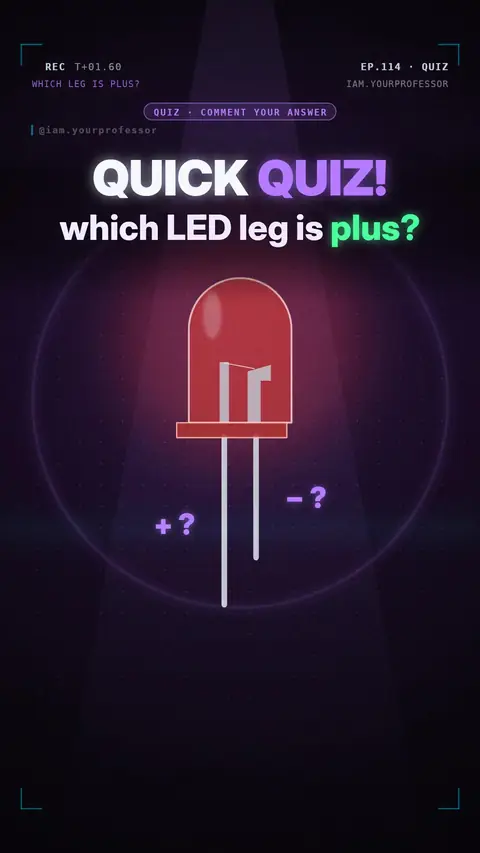
The longer leg is the anode (+). The short leg, next to the flat edge on the rim, is the cathode (−). The resistor can go on either side of the LED — the current is the same everywhere in a series loop.
Frequently asked questions
What resistor do I need for an LED on 5V?
About 220 Ω for red, yellow or green LEDs and about 120–150 Ω for blue or white LEDs, giving roughly 10–15 mA.
Can I use a 1k resistor for an LED?
Yes. On 5 V a red LED with 1 kΩ gets about 3 mA: dimmer, but clearly visible and very safe. On 12 V, 1 kΩ gives about 10 mA, which is fine.
What resistor do I need for an LED on 12V?
About 680 Ω for a red or a white LED at about 15 mA, and use a ½ W resistor if you go to 20 mA.
Do I need a resistor for an LED on 3.3V?
For red LEDs yes, about 100 Ω. Blue and white LEDs need about 3.2 V, so on 3.3 V there is almost no room left: they glow dimly and unevenly, so a driver or a higher supply works better.
What happens if I use an LED without a resistor?
The current rises until something fails: the LED overheats and dies (often in under a second), and on a microcontroller you can also damage the pin.