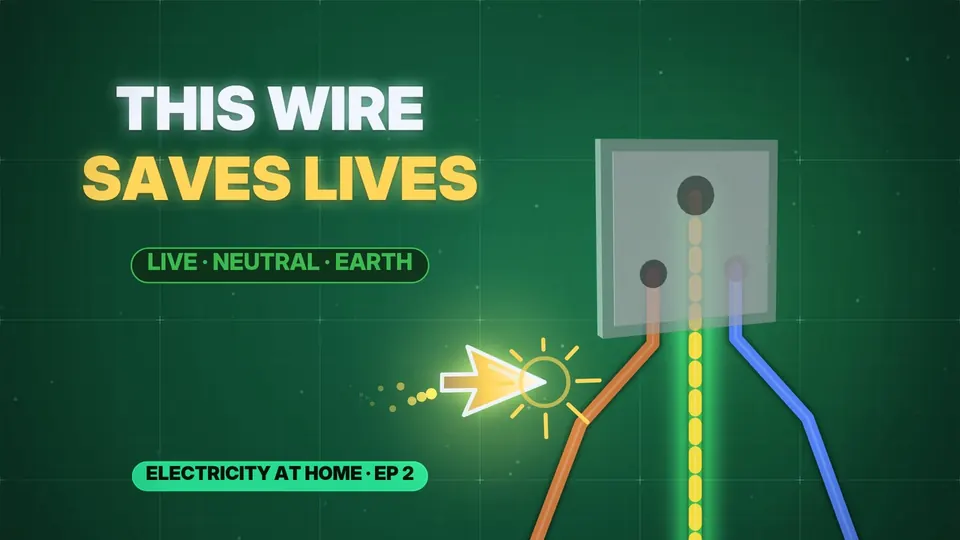
Electricity at Home: from the Power Plant to Your Socket · EPISODE 2 · 2:47
Inside Your Socket — Live, Neutral and Earth
Look at the socket on your wall: two holes, maybe three. One of those wires does nothing at all — until the day it saves your life. What live, neutral and earth really do, why a live wire shocks you but not a bird, and how the earth wire trips the breaker when something goes wrong. Episode 2 of Electricity at Home, in under 3 minutes.
// CHAPTERS · TAP TO JUMP
// IN THIS EPISODE
What you'll learn
- Electricity only flows in a full loop: out on the live wire, through the appliance, back on the neutral.
- Live = the push: 230 V · 50 Hz in India, the UK and Europe; 120 V · 60 Hz in the USA and Canada.
- Neutral = the way back. It's joined to the earth at the transformer, so it sits close to 0 V — but it still carries current, so never treat it as safe.
- Colours: UK / Europe live brown, neutral blue, earth green-yellow · USA / Canada hot black, neutral white, ground green or bare copper · many Indian homes red, black, green (newer wiring brown, blue, green-yellow). Always check your country's rules.
- A bird on one wire is fine: no loop. You on the floor touching a live wire close the loop through your body and the ground back to the transformer → a shock.
- The earth wire runs from your socket to a metal rod in the ground and to the metal case of things like kettles, irons and washing machines. Normally it carries nothing.
- If a loose live wire touches the case: without earth the case sits at mains voltage and the current goes through you; with earth a huge current rushes down the earth wire and trips the breaker or blows the fuse in a split second.
- The earth pin is often the longest: it connects first and lets go last. Two-pin chargers marked ⧈ are double insulated: no metal case to earth.
// 30-SECOND SHORTS ON THIS
Quick refreshers
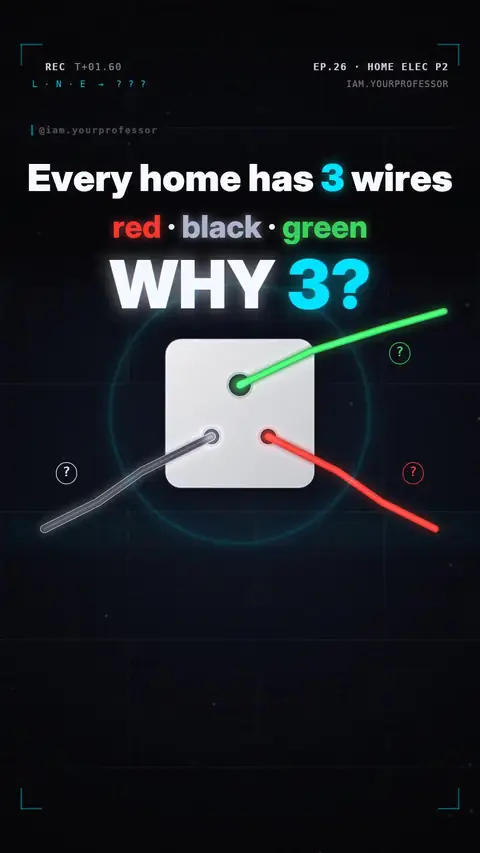 EP.26 · Home Electrical · 2Red, black, green: the 3 wires in your home
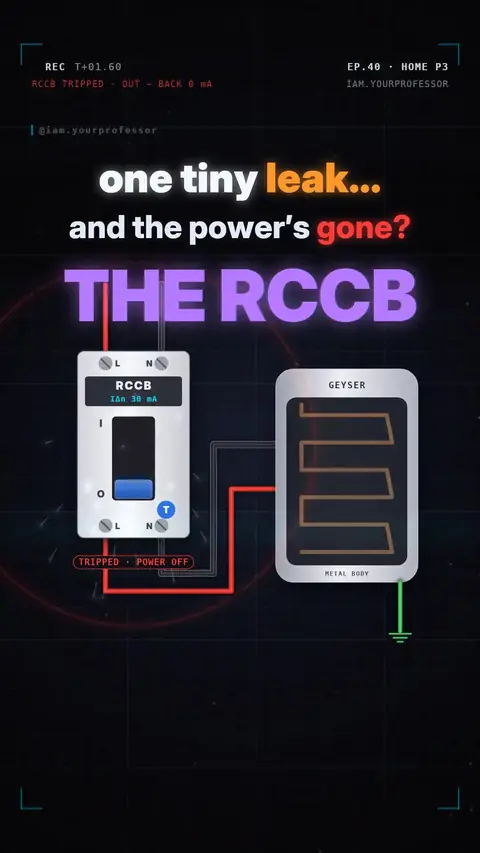 EP.40 · Home Electrical · 3RCCB: the switch that trips on a leak
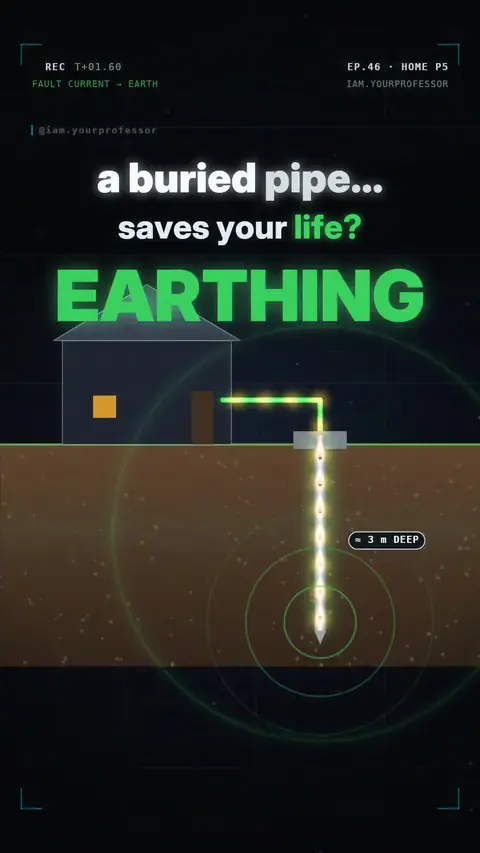 EP.46 · Home Electrical · 5Earthing: how an earth pit works
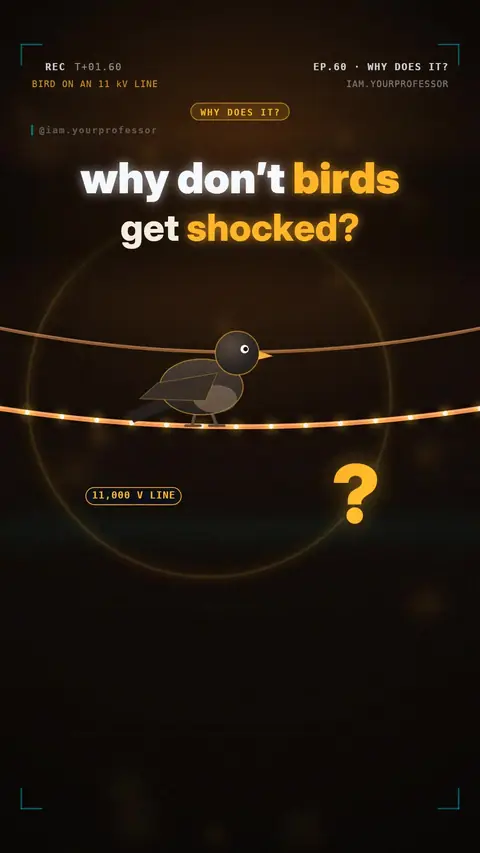 EP.60 · Why does…?Why don't birds get shocked on power lines?
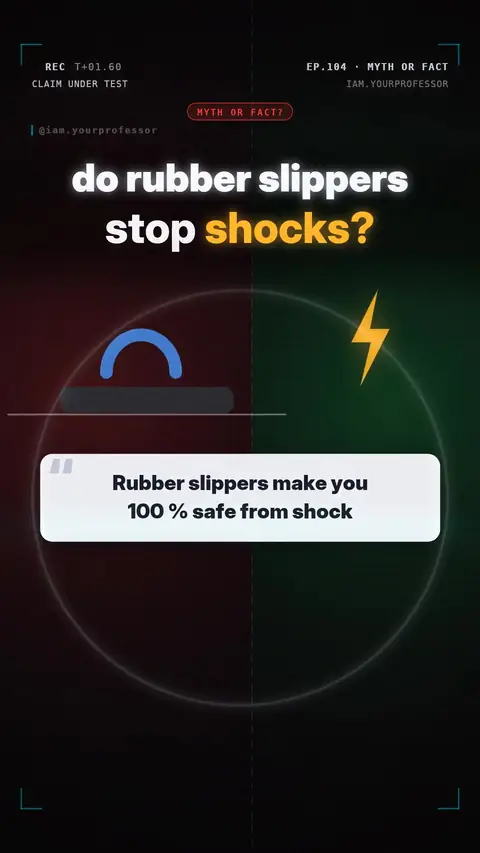 MYTH
EP.104 · Myth or FactMyth or Fact #7: "Rubber slippers make you 100 % safe from shock"
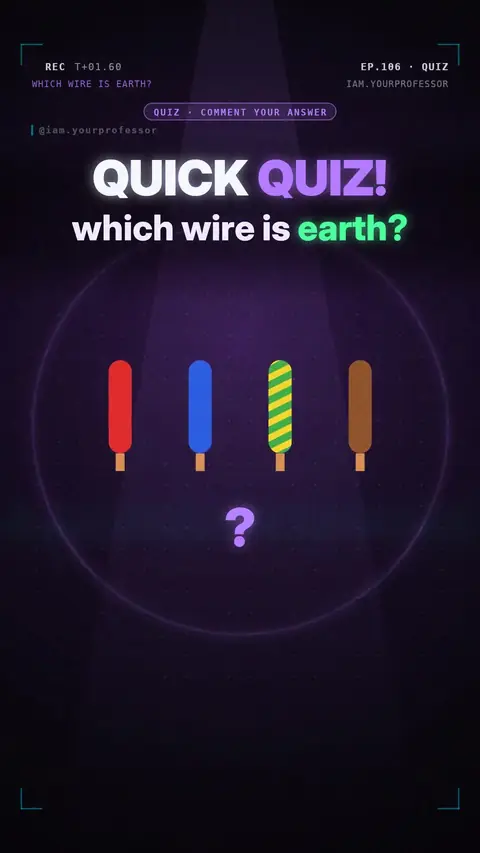 EP.106 · QuizQuiz #7: Which wire is earth?
// NEWSLETTER · FREE
Get the next episode first
One email when a new episode drops. No spam.
✓ You're on the list! We'll email you when new lessons drop.
By joining you agree to the privacy policy.