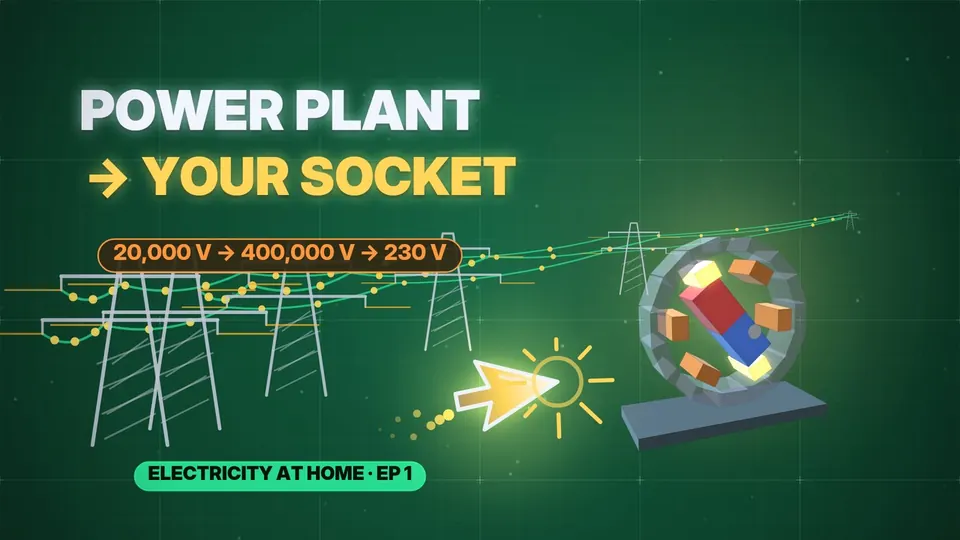
Electricity at Home: from the Power Plant to Your Socket · EPISODE 1 · 2:40
From the Power Plant to Your Socket
You flip a switch and the light comes on instantly — but that power was made far away, a split second ago. Follow it all the way: the generator's spinning magnet, why the big lines carry hundreds of thousands of volts (and why that wastes LESS power), the substation, the transformer on your street, and the 230 V or 120 V at your socket. Episode 1 of Electricity at Home, in under 3 minutes.
// CHAPTERS · TAP TO JUMP
// IN THIS EPISODE
What you'll learn
- Most power plants have a generator: a big magnet spinning inside copper coils. Steam (from coal, gas or a nuclear reactor), falling water or the wind turns it. Solar panels are the exception — nothing spins.
- The spinning magnet pushes electrons one way, then back: alternating current (AC). 50 cycles a second in India, the UK and Europe; 60 in the USA and Canada.
- A big generator makes about 11,000–25,000 V. A step-up transformer raises it to about 110,000–765,000 V for the long-distance lines.
- A transformer = two coils on one iron core. More turns on the output coil → more volts (3× the turns → 3× the volts).
- Same power = volts × amps: 10,000 V × 100 A = 100,000 V × 10 A. The heat lost in a wire grows with the current squared, so 10× less current = 100× less heat. That's why the big lines use such high voltage.
- A substation steps it down for the local lines (about 11,000 V in India / UK / Europe, about 4,000–35,000 V in the USA), then a transformer on a pole or in a street box gives 230 V (120 V in the USA and Canada).
- The wires store nothing: power plants make your power the very moment you use it.
// 30-SECOND SHORTS ON THIS
Quick refreshers
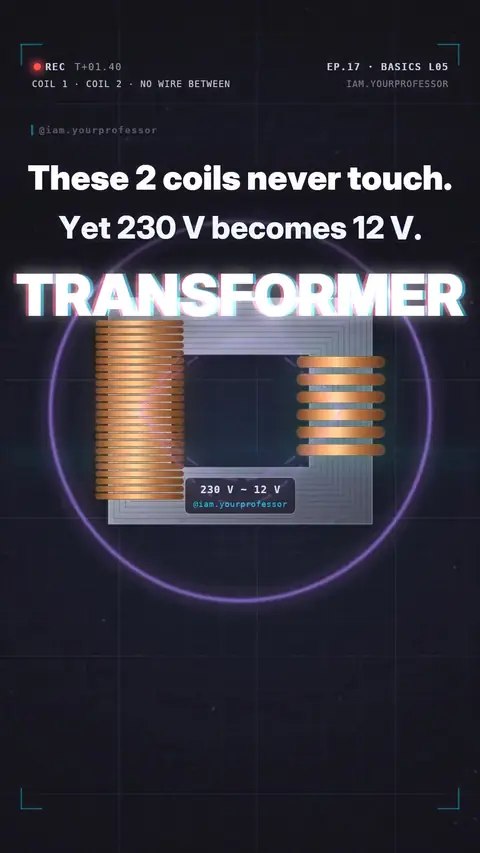 EP.17 · Electronics Basics · 5How a transformer works
 EP.60 · Why does…?Why don't birds get shocked on power lines?
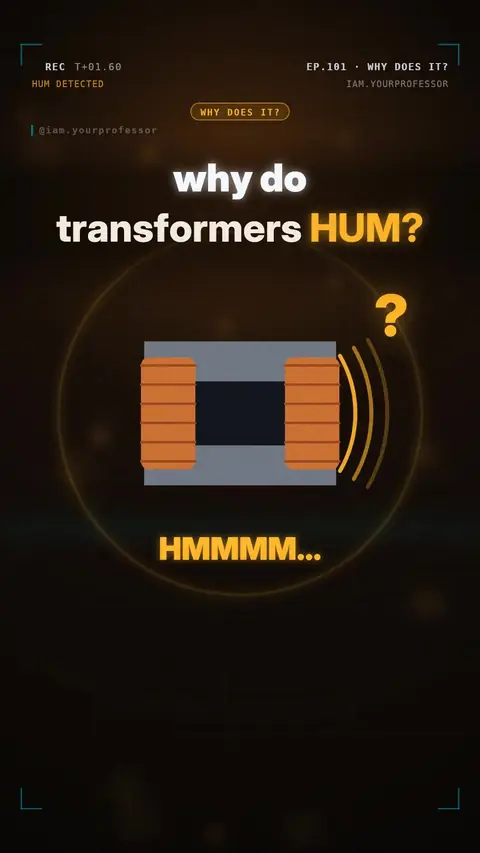 EP.101 · Why does…?Why does…? #7: Why do transformers hum?
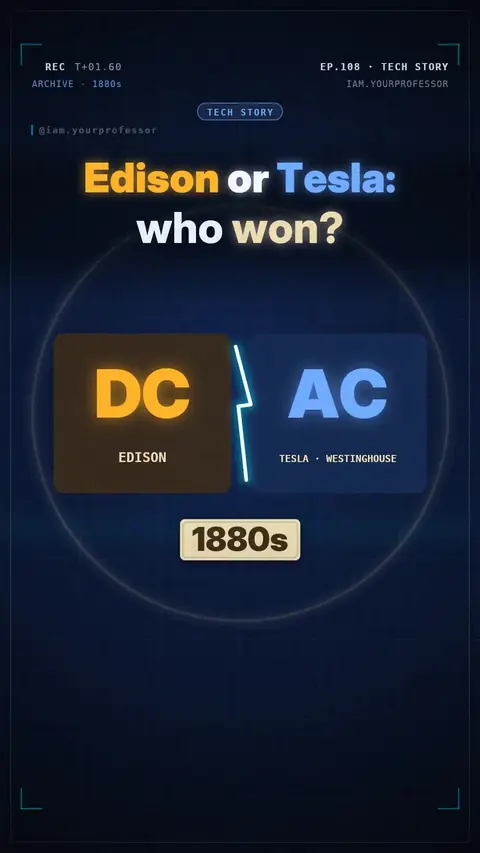 EP.108 · Tech StoryTech Story #3: The war of the currents — Edison's DC vs Tesla + Westinghouse's AC
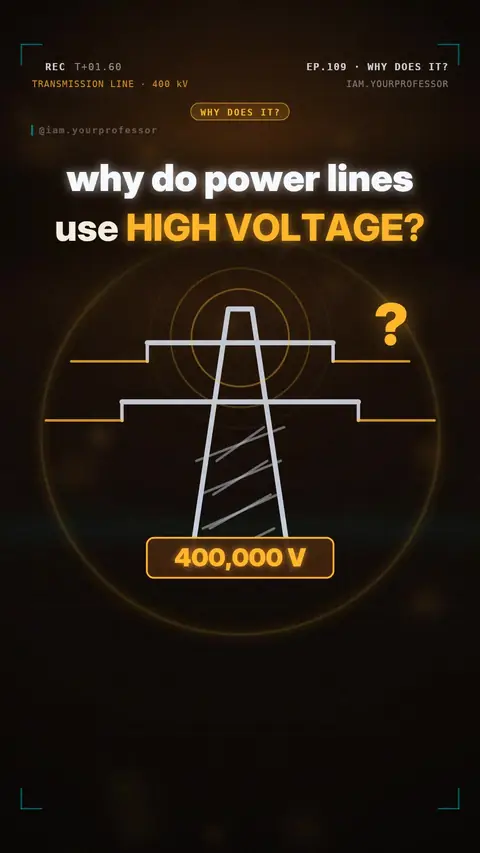 EP.109 · Why does…?Why does…? #8: Why do power lines use such high voltage?
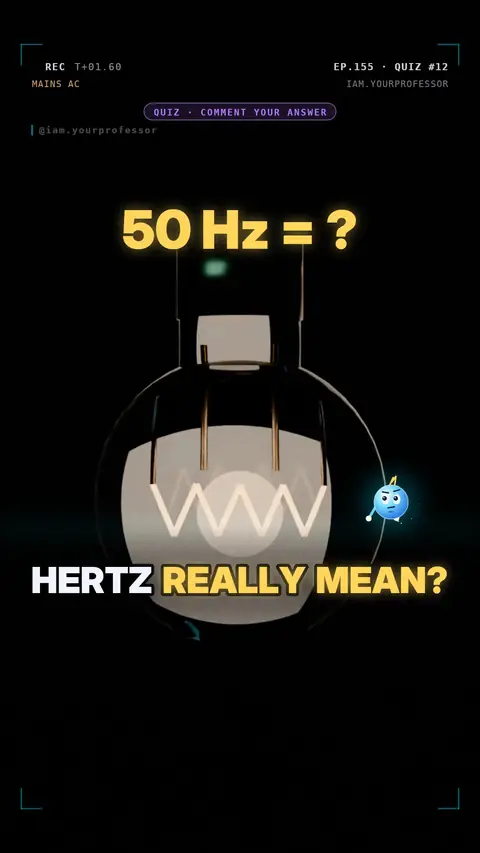 EP.155 · QuizQuiz #12: What does 50 Hz mean?
// NEWSLETTER · FREE
Get the next episode first
One email when a new episode drops. No spam.
✓ You're on the list! We'll email you when new lessons drop.
By joining you agree to the privacy policy.