Tech Story #10 · Golden Age G3: Ibn al-Haytham — light, the eye and the camera
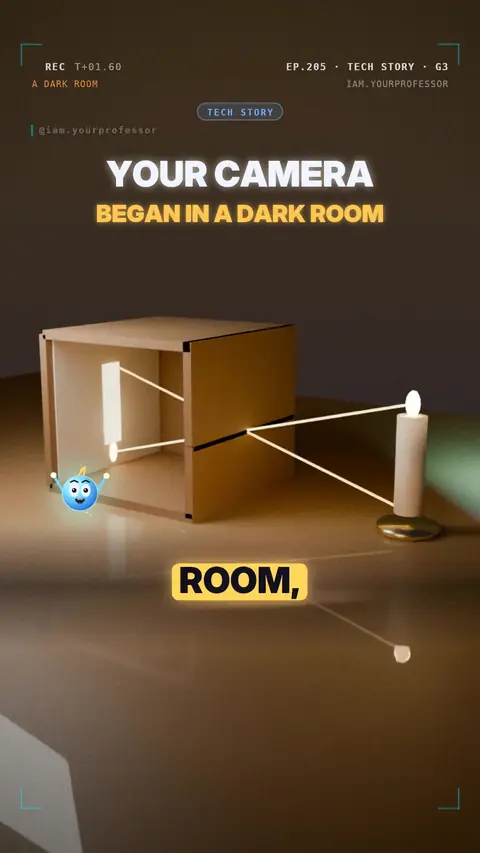
Basra/Cairo, Book of Optics (about 1011–1021): light travels into the eye, the camera obscura makes an upside-down image, ideas are tested by experiment — the idea behind your phone camera.
Your phone camera began in a dark room — about 1,000 years ago! 📷🕯️
👁️ The old idea (Euclid, Ptolemy): your eyes shoot out rays, like torches.
💡 About 1011–1021, Ibn al-Haytham (Basra → Cairo) wrote the Book of Optics and said NO: light comes INTO the eye.
🕳️ Make a tiny hole in a dark room (a "camera obscura") and the world outside appears on the wall — upside down!
🧪 How did he prove it? Experiments — test, measure, repeat, again and again. He was one of the first to insist on it.
📱 Your phone camera works the same way: a lens instead of the hole, a sensor instead of the wall (the chip flips the picture).
Read the voiceover (transcript)
- Your camera began in a dark room, long ago!
- Old idea: your eyes shoot out rays, like torches!
- Ibn al Haytham said no: light comes into the eye!
- A tiny hole in a dark room makes an upside-down picture!
- So how did he prove it?
- Experiments, again and again!
- Your phone camera works this way!
- Next: a music machine you could program! Follow for more!
Related lessons
 EP.189 · Tech StoryTech Story #8 · Golden Age G1: al-Khwarizmi — the word 'algorithm' is his name
 EP.221 · Tech StoryTech Story #12 · Golden Age G5: al-Jazari — the robots of 1206
 EP.181 · Tech StoryTech Story #7: The first microprocessor — Intel 4004
 EP.229 · Tech StoryTech Story #13 · Golden Age G6: al-Kindi — the first codebreaker
Get new lessons + early access to the full course
One email when new lessons drop. No spam, unsubscribe any time.
✓ You're on the list! We'll email you when new lessons drop.
By joining you agree to the privacy policy.