Explained Simply #18: how does an LED make light?
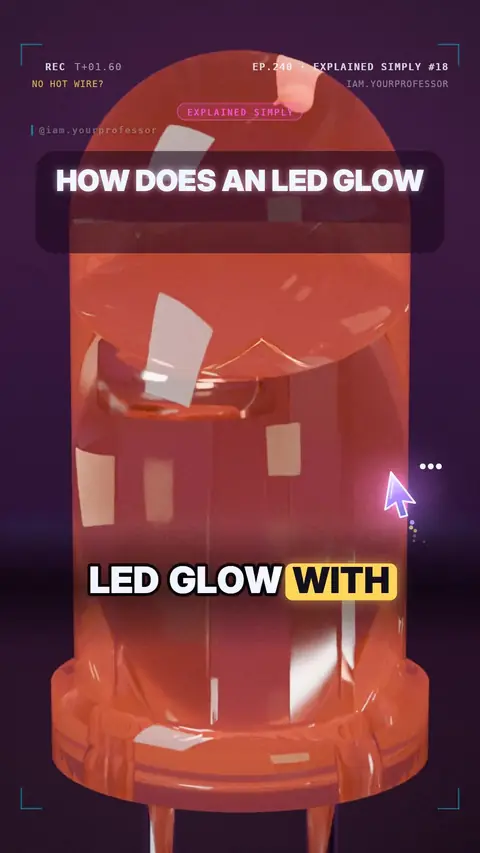
Electrons fall from a higher energy level to a lower one at the junction and give off the difference as light; the material sets the colour.
How does an LED glow without a hot wire? 💡✨
🧱 Inside the tiny chip: two layers. N has extra electrons, P has "holes" (missing electrons).
🔋 Push current through, and the electrons cross the border between them.
⬇️ Each electron drops into a hole — and gives off its extra energy as a tiny flash of light (a photon)!
🤔 So what sets the colour?
🎨 The material! It sets how big that drop is: small drop = red, medium = green, bigger drop = blue.
⚪ White LEDs? Usually a blue LED + a yellow coating. Blue + yellow looks white to your eyes.
🌡️ No glowing-hot wire = far less heat, far less power.
Read the voiceover (transcript)
- How does an LED glow with no hot wire?
- Two layers: extra electrons, and holes.
- Push current through, and electrons cross the border.
- Each one drops into a hole and gives off a flash of light!
- So what sets the colour?
- The material! Bigger drop, bluer light.
- White? Blue, plus a yellow coat.
- Next: how traffic lights spot cars. Follow for more!
Related lessons
 EP.224 · Explained SimplyExplained Simply #16: how do wireless earbuds talk to your phone?
 EP.216 · Explained SimplyExplained Simply #15: what is 5G, really?
 EP.208 · Explained SimplyExplained Simply #14: how does a battery store electricity?
 EP.200 · Explained SimplyExplained Simply #13: how does a phone camera turn light into a photo?
Get new lessons + early access to the full course
One email when new lessons drop. No spam, unsubscribe any time.
✓ You're on the list! We'll email you when new lessons drop.
By joining you agree to the privacy policy.