Explained Simply #13: how does a phone camera turn light into a photo?
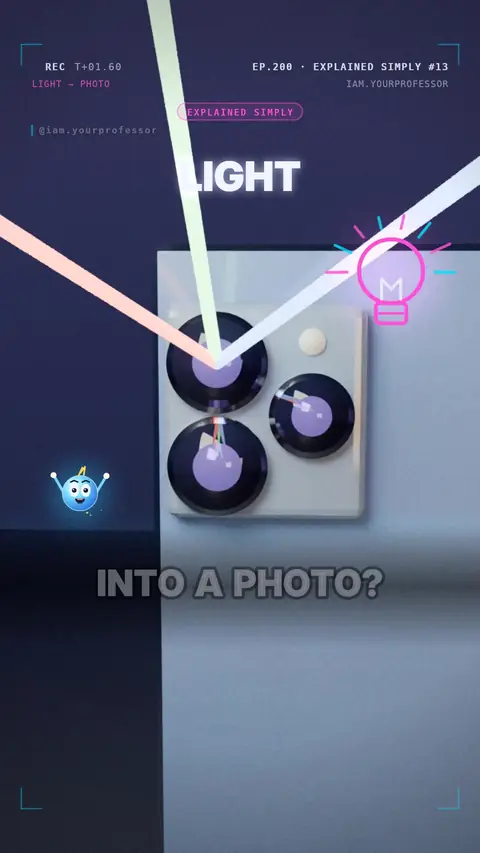
Millions of tiny light sensors (pixels) count the light that hits them; a grid of red, green and blue filters on top gives the colours.
How does your phone turn LIGHT into a PHOTO? 📸✨
🔍 The lens squeezes the light onto a tiny chip — the image sensor.
🟦 The chip holds millions of pixels (a 12 MP camera ≈ 12 million). Each one is like a tiny light bucket.
⚡ More light → more electrons → a bigger number (0 = dark … 255 = bright).
🎨 But a pixel only measures brightness, not colour! So red, green and blue filters sit on top — twice as many green, because our eyes love green.
🧠 Then the phone's chip mixes the neighbours together to give every pixel its full colour. That's your photo!
Read the voiceover (transcript)
- How does your phone turn light into a photo?
- The lens squeezes the light onto a tiny chip.
- It holds millions of pixels, each a tiny light bucket!
- More light, more electrons, a bigger number.
- But pixels can't see colour. So how?
- Red, green and blue filters on top!
- Then the chip mixes the colours.
- Next: how does a battery store electricity? Follow for more!
Related lessons




Get new lessons + early access to the full course
One email when new lessons drop. No spam, unsubscribe any time.
✓ You're on the list! We'll email you when new lessons drop.
By joining you agree to the privacy policy.