Capacitors Part 7: Supercapacitors — a capacitor that acts like a battery
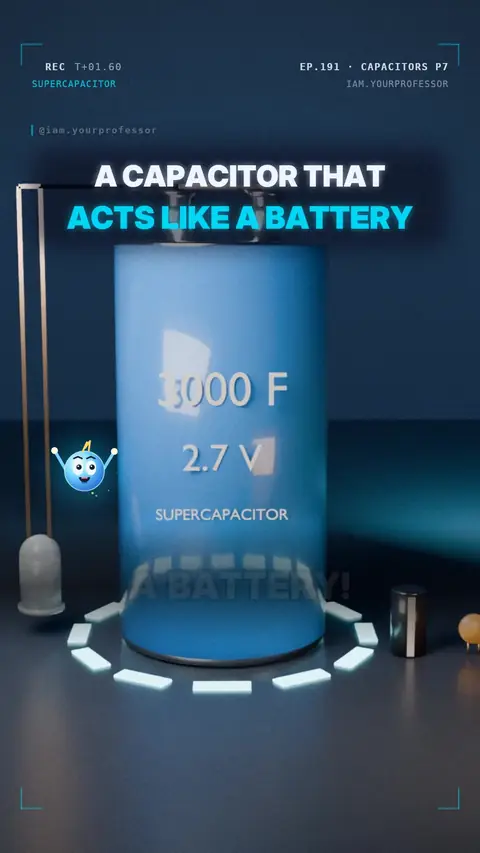
A supercapacitor stores thousands of times more charge than a normal capacitor (farads, not microfarads) and charges in seconds, but holds far less energy than a battery of the same size.
Meet the supercapacitor — a capacitor that acts like a battery! ⚡🔋
🔹 Most capacitors hold microfarads (millionths of a farad). This one: 3,000 FARADS — about 30 million times a 100 µF cap.
🧽 The secret: sponge-like activated carbon. 1 gram has up to ~2,000 m² of surface, and the charge sits as ions just nanometres from it.
⏱️ No chemical reaction → it charges in seconds and lasts about 1,000,000 cycles (a phone battery: ~1,000).
❓ More energy than a battery? NO — about 20× LESS for the same weight.
🚌 So it's perfect for quick bursts: capacitor buses that top up at every stop, braking energy, camera flashes, memory backup.
Read the voiceover (transcript)
- Meet a capacitor that acts like a battery!
- Most caps: microfarads. This one: three thousand farads!
- The secret: sponge-like carbon with a giant surface!
- It charges in seconds and lasts a million cycles!
- Guess: more energy than a battery?
- No! Twenty times less than a battery.
- Great for quick bursts, like buses!
- Next: why big capacitors still shock you. Follow for Part 8!
Related lessons
Get new lessons + early access to the full course
One email when new lessons drop. No spam, unsubscribe any time.
✓ You're on the list! We'll email you when new lessons drop.
By joining you agree to the privacy policy.