The DIODE: the one-way valve that turns AC into DC
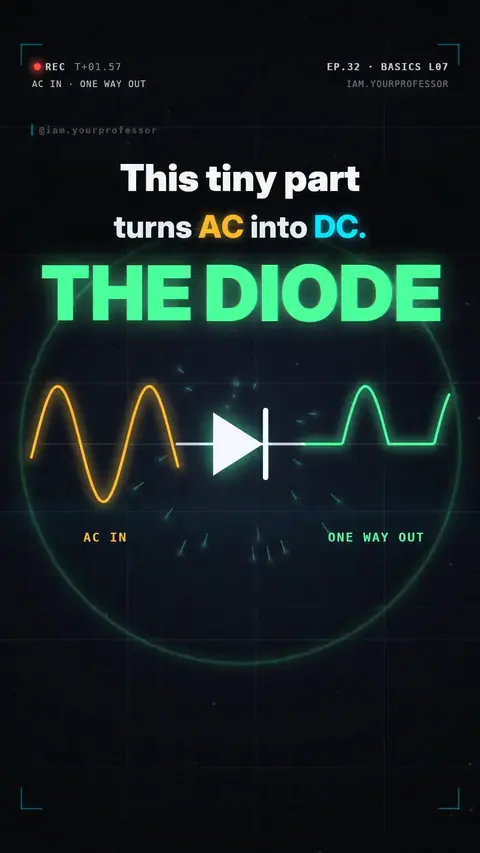
Inside a diode P meets N with a barrier: forward it conducts (~0.7 V drop), reversed it blocks; 1 diode = half-wave, a 4-diode bridge = full-wave; the silver band is the cathode.
This tiny part turns AC into DC ⚡ (the diode lesson we promised!)
1️⃣ ONE WAY: inside a diode, a P side meets an N side. Between them is a thin BARRIER.
Forward (+ on the anode): the barrier shrinks, current flows. The diode "uses up" about 0.7 V. With 5 V and 1 kΩ you get (5 − 0.7) ÷ 1000 = 4.3 mA.
Flip the battery: the barrier gets wider and NO current flows.
2️⃣ HALF-WAVE: put 1 diode in an AC loop. The top halves pass, the bottom halves are blocked. You get DC, but half the wave is lost (gaps!).
3️⃣ FULL-WAVE: a bridge of 4 diodes. 2 diodes work on each half, so the bottom half gets flipped UP. The load sees current going ONE way, every half.
4️⃣ READ THE PART: the silver band = the bar in the symbol = the cathode (− side).
Add a capacitor and you get smooth DC (see our AC → DC power supply reel). AC is shown slowed down (real: 50 Hz).
Related lessons
Get new lessons + early access to the full course
One email when new lessons drop. No spam, unsubscribe any time.
✓ You're on the list. Check your inbox to confirm.
By joining you agree to the privacy policy.