How a transformer works
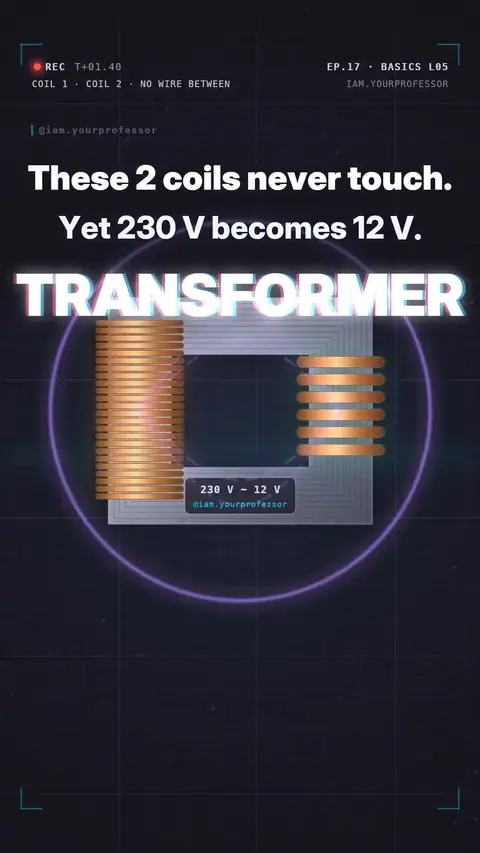
Two coils on an iron core: AC makes a changing magnetic field that makes voltage in coil 2; turns set the volts (Vout = Vin × Ns ÷ Np, 230 V → 12 V), and DC gives 0 V out.
These 2 coils never touch… so how does 230 V become 12 V? 🧲
A transformer is just 2 copper coils wound on one iron core. No wire connects them.
1. AC in coil 1 makes a CHANGING magnetic field in the iron.
2. That changing field makes a new AC voltage in coil 2.
3. Turns set the volts: Vout = Vin × Ns ÷ Np → 230 V × 60 ÷ 1150 = 12 V.
Fewer volts, more current: power in ≈ power out (230 V × 0.05 A ≈ 12 V × 1 A).
Try DC and you get 0 V out. A steady field makes no voltage, so transformers only work on AC.
Related lessons
Get new lessons + early access to the full course
One email when new lessons drop. No spam, unsubscribe any time.
✓ You're on the list. Check your inbox to confirm.
By joining you agree to the privacy policy.