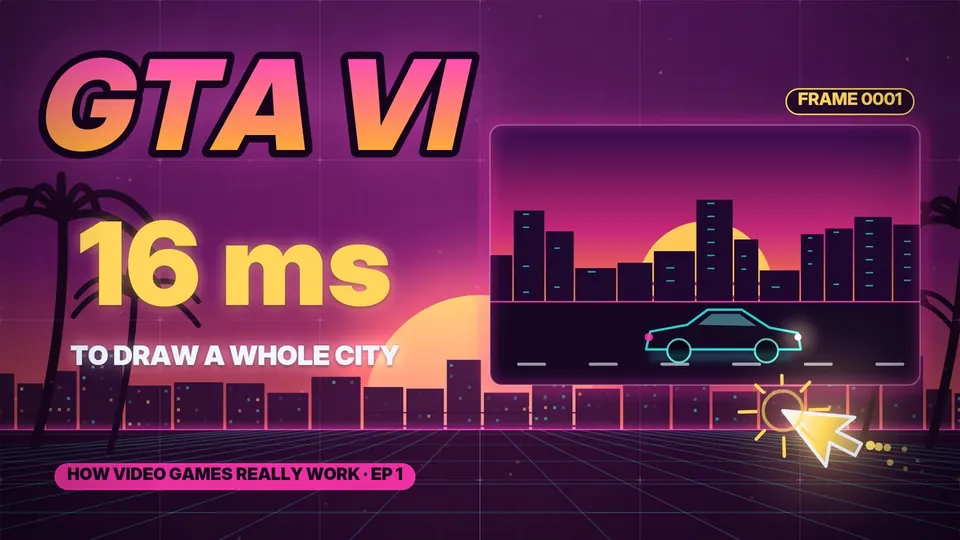
How Video Games Really Work: the Tech Behind GTA VI · EPISODE 1 · 2:48
What Your Console Does in 16 Milliseconds
GTA VI is out on 19 November — and to keep that whole city moving, your console rebuilds it in a few milliseconds. Again and again. How? Frames and fps, the game loop (controller → CPU → GPU → TV), why a late frame makes the game stutter, and what is really inside a PS5 / Xbox Series X. Episode 1 of How Video Games Really Work: the Tech Behind GTA VI, in under 3 minutes.
// CHAPTERS · TAP TO JUMP
// IN THIS EPISODE
What you'll learn
- A game is a flipbook that draws itself: every picture is a frame. fps = frames per second (30 looks okay, 60 looks smooth).
- 1 second = 1,000 milliseconds. At 60 fps that's 1,000 ÷ 60 = 16.7 ms per frame (30 fps = 33.3 ms). A blink takes about 150 ms — the console draws about 9 pictures in it. GTA VI's frame rate isn't confirmed yet; the deadline idea is the same.
- Every frame runs the game loop: 1 read your controller · 2 the CPU moves the world (cars, people, traffic, crashes) · 3 the GPU draws it (millions of tiny triangles, then 3840 × 2160 ≈ 8.3 million pixels on a 4K TV) · 4 the picture goes to your TV — then back to step 1.
- A frame that misses its deadline: the TV shows the old picture again → a stutter (a dropped frame). More frames per second also means a shorter wait between your button and the screen.
- Inside a PS5 / Xbox Series X: one chip with the CPU (8 strong cores) and the GPU (thousands of tiny cores), 16 GB of fast shared memory, a fast SSD that loads the next part of the world before you get there, and ≈ 200 W of heat → a big fan.
// 30-SECOND SHORTS ON THIS
Quick refreshers
// NEWSLETTER · FREE
Get the next episode first
One email when a new episode drops. No spam.
✓ You're on the list! We'll email you when new lessons drop.
By joining you agree to the privacy policy.