How to Calculate Your Electricity Bill (kWh per Appliance) + Free Calculator
Calculate your electricity bill from watts, hours and price per kWh. Simple formula, worked examples for AC, fridge, heater and TV, plus a free calculator.
ON THIS PAGE
- Free electricity bill calculator
- What is 1 kWh ("1 unit") of electricity?
- The formula, step by step
- Worked examples
- Example 1: air conditioner
- Example 2: fridge
- Example 3: room heater
- Example 4: TV on standby
- Typical appliance watts (quick table)
- Why your real bill can be higher than the calculation
- 7 easy ways to cut your electricity bill
- Frequently asked questions
Your electricity bill looks complicated, but it is built from one tiny formula. Once you know it, you can work out what any appliance costs you — your air conditioner, your fridge, the TV left on standby — and find out exactly where your money goes.
Free electricity bill calculator
Pick your appliances, type how many hours a day they run, and enter the price per kWh from your bill. The calculator shows the kWh per day, per month and the cost — and which appliance uses the most.
⚡ LOADING THE CALCULATOR…
Free, no sign-up. Prefer a bigger screen? Open the Electricity bill calculator calculator in the Lab →
What is 1 kWh ("1 unit") of electricity?
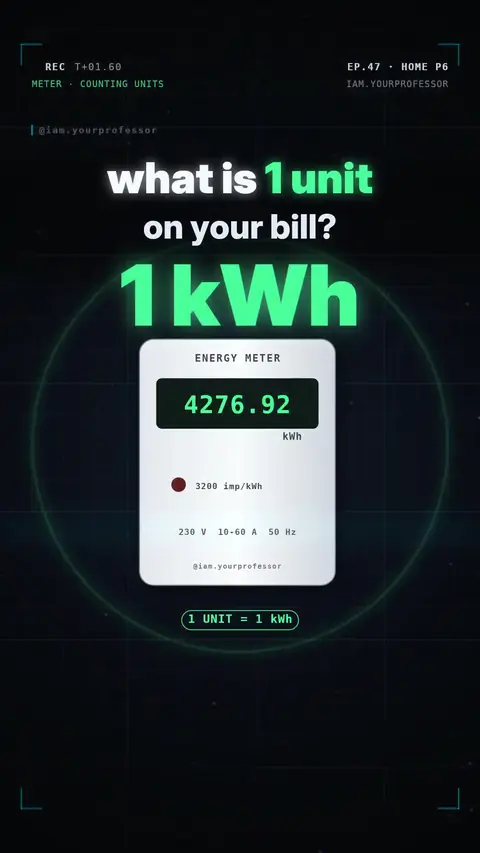
Your power company does not charge you for watts. It charges you for energy: how much power you use and for how long. The unit for that is the kilowatt-hour (kWh).
- 1 kWh = 1,000 watts running for 1 hour.
- In India and many other countries, 1 kWh is called "1 unit" on the bill. Same thing.
- A 100 W TV running for 10 hours also uses 1 kWh (100 × 10 = 1,000 Wh).
- A 9 W LED bulb needs about 111 hours to use 1 kWh. A 2,000 W water heater (geyser) uses it in just 30 minutes.
That is why heating and cooling appliances dominate almost every bill.
The formula, step by step
- Find the watts. Look at the label on the back or bottom of the appliance (or the charger). It says something like
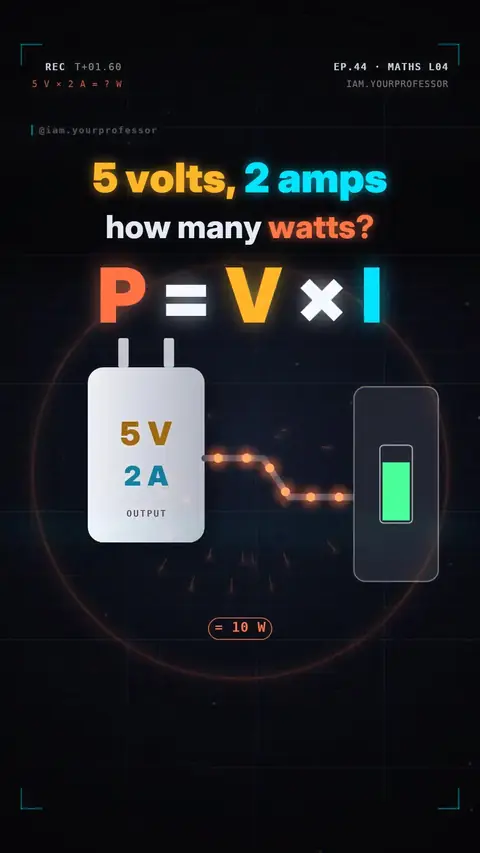
1500Wor220–240V ~ 50Hz 6.5A. - If only amps are given, multiply: watts ≈ volts × amps. A 6.5 A appliance on 230 V ≈ 1,500 W (on 120 V, a 12.5 A appliance ≈ 1,500 W).
- Estimate hours per day honestly — this is where most guesses go wrong.
- Divide by 1,000 to turn watt-hours into kilowatt-hours.
- Multiply by your price per kWh from your bill (include taxes and fixed charges for the real number).
Worked examples
Example 1: air conditioner
A 1.5-ton split AC is rated around 1,500 W while the compressor runs. Used 6 hours a day:
- 1,500 × 6 ÷ 1,000 = 9 kWh per day
- 9 × 30 = 270 kWh per month
- At $0.15/kWh → $40.50 a month. At ₹8 per unit → ₹2,160 a month.
An inverter AC slows its compressor down once the room is cool, so its real average is often 30–50 % lower. Your meter is the final judge.
Example 2: fridge
A fridge label may say 100–150 W, but the compressor switches on and off. Its real average is closer to 40–60 W over a day. That is why fridges show a yearly energy figure on their energy label (for example 250 kWh/year).
- 250 kWh ÷ 12 ≈ 21 kWh a month → about $3.10 a month at $0.15.
Example 3: room heater
A 1,000 W heater for 3 hours a day = 3 kWh a day = 90 kWh a month. Heaters turn every watt into heat, so there is no "efficient" heater of the same watts — only fewer hours or better insulation.
Example 4: TV on standby
A modern TV on standby uses about 0.5–1 W. Over a year: 1 W × 8,760 h = 8.76 kWh — about $1.30 a year. Small, but old set-top boxes on standby can use 10–20 W, which is ten times more.
Typical appliance watts (quick table)
| Appliance | Typical watts | Hours/day | kWh per month |
|---|---|---|---|
| LED bulb | 9 W | 6 | 1.6 |
| Ceiling fan | 50–75 W | 8 | 12–18 |
| Wi-Fi router | 10 W | 24 | 7.2 |
| Fridge (average draw) | 40–60 W | 24 | 29–43 |
| TV (LED, 43–55") | 60–100 W | 4 | 7–12 |
| Laptop | 45–65 W | 5 | 7–10 |
| Air conditioner (1.5 ton) | 1,200–1,800 W | 6 | 216–324 |
| Room heater | 1,000–2,000 W | 3 | 90–180 |
| Water heater / geyser | 2,000 W | 1 | 60 |
| Microwave | 1,000 W | 0.3 | 9 |
These are typical numbers — always check the label of your appliance. For a longer list, see the appliance power consumption chart.
Why your real bill can be higher than the calculation
- Fixed charges: most bills add a monthly connection or meter fee.
- Slab (tiered) pricing: in many places the first units are cheap and the next ones cost more.
- Time-of-use pricing: some utilities charge more in the evening peak.
- Taxes and duties on top of the energy price.
- Hidden loads: water pumps, a second fridge, a desktop PC left on, chargers and standby devices.
To find your real price per kWh, divide the total amount on your bill by the kWh you used.
7 easy ways to cut your electricity bill
- Set the AC to 24–26 °C (75–79 °F). Each degree cooler adds roughly 3–6 % to its energy use.
- Swap every old bulb for LED. A 9 W LED gives the same light as a 60 W incandescent bulb.
- Run the water heater for less time — or use a timer.
- Keep the fridge door seals clean and leave space behind it for air.
- Switch off at the wall devices with big standby (old set-top boxes, speakers).
- Use fans with the AC: a fan lets you feel cool at a higher AC temperature.
- Measure the big users with a plug-in power meter for a week.
Add your appliances, hours and price per kWh — see what each one really costs per month.
Frequently asked questions
How do I calculate electricity cost per hour?
Multiply the appliance's watts by your price per kWh and divide by 1,000. A 1,000 W heater at $0.15 per kWh costs 1,000 × 0.15 ÷ 1,000 = $0.15 per hour.
What does 1 unit of electricity mean?
1 unit is 1 kilowatt-hour (kWh): 1,000 watts used for 1 hour, or 100 watts for 10 hours.
How many units does an AC use per month?
A 1.5-ton AC (about 1,500 W) running 6 hours a day uses about 9 units a day, or about 270 units a month. An inverter AC often uses 30–50 % less.
How many kWh does a house use per month?
It varies a lot by country and climate: a small home with fans and LED lights may use 100–200 kWh a month, while a home with air conditioning or electric heating can use 500–1,000 kWh or more.
Is watts the same as kWh?
No. Watts measure power (how fast energy is used right now). kWh measures energy (power × time). Your bill charges for kWh.
Do appliances use power when switched off?
Many use a little on standby: usually under 1 W for modern TVs and chargers, but old set-top boxes and some speakers use 5–20 W. Switching off at the wall stops it completely.