How does a microwave heat your food?
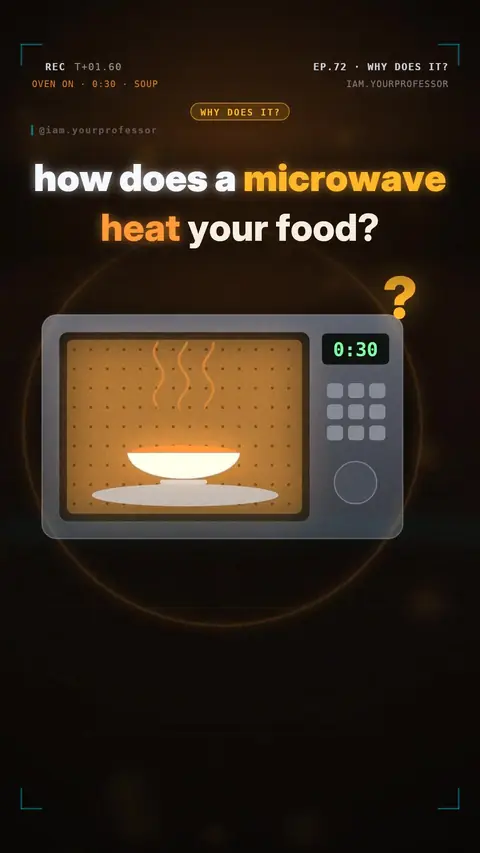
2.45 GHz waves twist water molecules back and forth billions of times a second → friction heat.
How does a microwave heat your food? 🍲⚡
1️⃣ THE MAGNETRON: a part inside the oven makes microwaves at 2.45 GHz (each wave is about 12 cm long). The metal walls bounce them around, and the mesh in the door keeps them inside.
2️⃣ THE WATER: a water molecule has a minus end (oxygen) and a plus end (hydrogen). The microwaves' field flips direction billions of times a second, and the water keeps twisting to follow it.
3️⃣ SHAKING = HEAT: all that twisting and bumping turns into heat. The plate spins so the food passes through the hot and cold spots. Tip: stir halfway for even heat.
📌 Waves shake water. Water gets hot.
Read the voiceover (transcript)
- How does a microwave heat your food?
- A part called the magnetron makes microwaves. The metal walls bounce them around.
- Water has a plus end and a minus end. The waves flip it billions of times a second!
- All that shaking turns into heat. The plate spins, so there are fewer cold spots.
- Waves shake water. Water gets hot!
- Next: why LED bulbs last so long! Follow for more!
Related lessons



Get new lessons + early access to the full course
One email when new lessons drop. No spam, unsubscribe any time.
✓ You're on the list. Check your inbox to confirm.
By joining you agree to the privacy policy.