MCB: overload vs short circuit
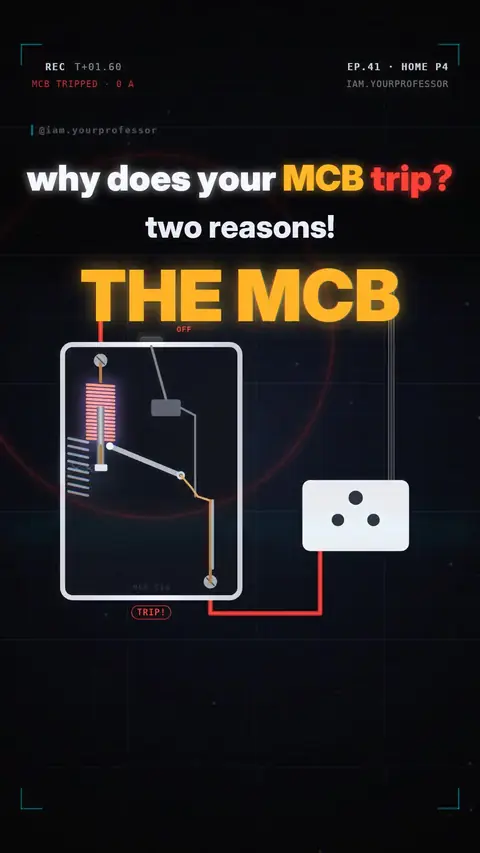
The two trip parts inside an MCB (bimetal for overload, magnetic coil for a short) and how to pick 6 A / 16 A / 32 A.
Why does your MCB trip? Only 2 reasons 🔥🧲
1️⃣ INSIDE: current goes IN → through a magnetic COIL → the contacts → a BIMETAL strip → OUT. Both trip parts pull the same latch. An arc chute kills the spark when the contacts open.
2️⃣ OVERLOAD (heat, slow): 2 heaters (2 kW = 8.7 A each) + a kettle (1.5 kW = 6.5 A) on one 16 A circuit = 23.9 A, about 1.5× the rating. The bimetal strip warms up, bends, pushes the latch → OFF. This takes seconds to minutes (sped up in the video) — before the wire cooks.
3️⃣ SHORT CIRCUIT (magnet, instant): phase touches neutral → hundreds of amps. The coil yanks its plunger and snaps the contacts open in milliseconds (a C16 does this from about 80–160 A).
4️⃣ IT PROTECTS THE WIRE: pick the MCB for the wire. Typical: lights + fans 6 A (1.5 mm²), sockets + geyser 16 A (2.5 mm²), AC 25 A (4 mm²). Never fit a bigger one — the wire overheats instead.
An MCB does NOT catch a small leak to earth or a shock — that's the RCCB (Part 3).
⚠️ Wiring changes = licensed electrician, main switch OFF.
Read the voiceover (transcript)
- Why does your MCB trip? Two reasons!
- Inside: a bimetal strip for heat, and a coil for a short. Both pull the same latch.
- Too many heaters? Twenty-four amps on a sixteen amp breaker! The strip heats up, bends, and trips. Slowly.
- A short? Hundreds of amps! The coil snaps it open in milliseconds.
- It protects the wire. Never go bigger!
- Next: the earth pit! Follow for part five!
Related lessons
Get new lessons + early access to the full course
One email when new lessons drop. No spam, unsubscribe any time.
✓ You're on the list. Check your inbox to confirm.
By joining you agree to the privacy policy.