Why chips get hot (and how your phone cools them)
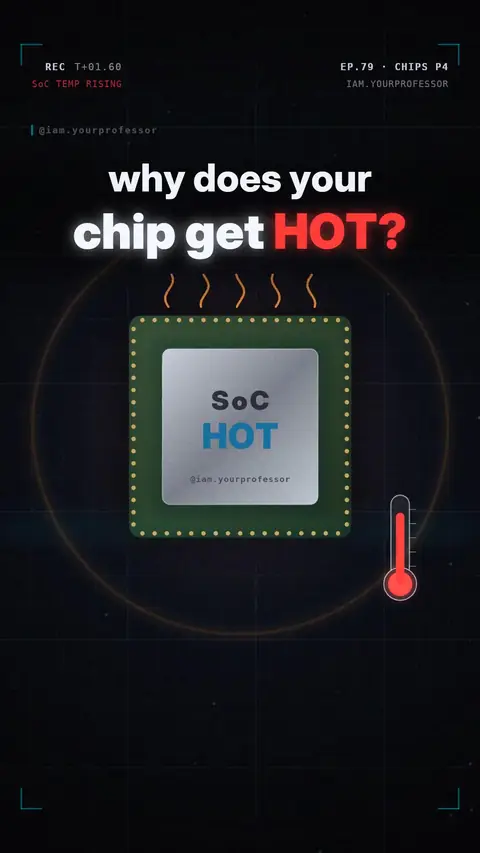
Every transistor switch spends a little energy as heat; billions switching billions of times a second add up, so phones spread it with copper, graphite and vapour chambers and slow down (throttle) when hot.
Why does your phone's chip get HOT? 🔥📱
1️⃣ SWITCHING: a phone chip has billions of transistors (around 15 billion), and they switch billions of times a second (a 3 GHz clock = 3 billion ticks a second). Every switch charges and empties tiny wires — and that makes a little heat.
2️⃣ WATTS IN = HEAT OUT: almost every watt a chip uses ends up as heat. Gaming? About 5 W — on a piece of silicon about 1 cm². Laptops use 15–45 W, big PC chips up to about 250 W, so they need heatsinks and fans.
3️⃣ KEEPING COOL: your phone has no fan. A thin copper vapor chamber (plus graphite sheets) spreads the heat across the whole phone, so it leaves through the screen and the back. Still too hot? The chip lowers its clock to make less heat — that's called throttling.
Switches make heat. Phones spread it! ♨️
Read the voiceover (transcript)
- Why does your phone's chip get hot?
- Billions of transistors switch billions of times a second. Every switch makes heat!
- Almost every watt a chip uses ends up as heat. Gaming? About five watts!
- No fan! A vapor chamber spreads the heat. Too hot? The chip slows itself down.
- Switches make heat. Phones spread it!
- Next: big and little cores. Follow for Part five!
Related lessons




Get new lessons + early access to the full course
One email when new lessons drop. No spam, unsubscribe any time.
✓ You're on the list. Check your inbox to confirm.
By joining you agree to the privacy policy.