From SAND to CHIP: how silicon becomes a chip
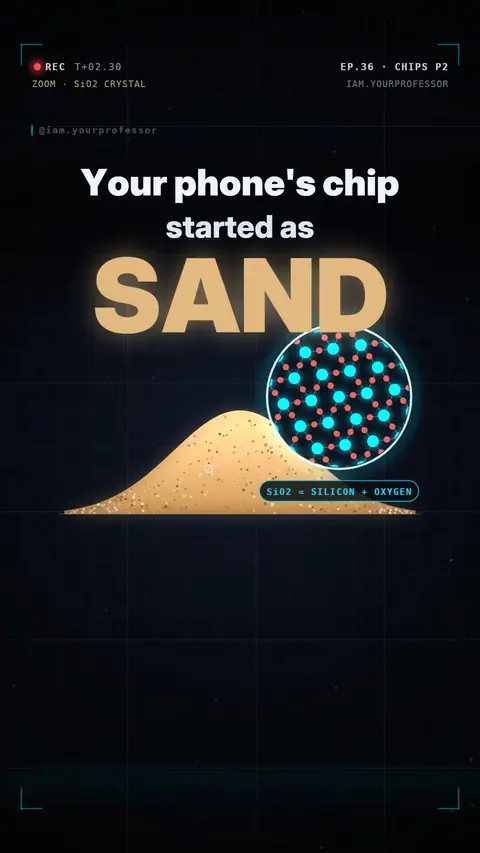
Sand (SiO2) is purified to 9-nines silicon, grown into one crystal, sliced into wafers, doped into P and N, and printed with light into hundreds of chips.
Your phone's chip started as SAND. 🏖️➡️💻
Sand is SiO2: silicon locked together with oxygen. Here's how it becomes a chip:
1️⃣ MAKE IT PURE: a furnace with carbon (about 2000 °C) pulls the oxygen off. Then it's cleaned to 99.9999999 % ("9 nines") = about 1 wrong atom per billion.
2️⃣ GROW ONE CRYSTAL: a tiny seed crystal dips into molten silicon (1414 °C), then is pulled up slowly while spinning. Every atom lines up in one perfect pattern. The ingot is 300 mm wide and up to about 2 m long. (Shown sped up. Real: more than a day.)
3️⃣ SLICE: a diamond wire saw cuts it into wafers thinner than 1 mm, then they're polished mirror-flat.
💡 WHY SILICON? Each silicon atom holds 4 neighbours, so pure silicon barely conducts. Add a pinch of phosphorus (5 outer electrons) → a free electron = N-type. Add boron (3) → a hole = P-type. P + N = diodes and transistors.
4️⃣ PRINT WITH LIGHT: light shines through a mask to print the circuit. Then etch, dope, add metal, layer on layer. Hundreds of steps, about 3 months. One wafer = hundreds of chips.
Related lessons



Get new lessons + early access to the full course
One email when new lessons drop. No spam, unsubscribe any time.
✓ You're on the list. Check your inbox to confirm.
By joining you agree to the privacy policy.