Tech Story #5: The blue LED that took 30 years
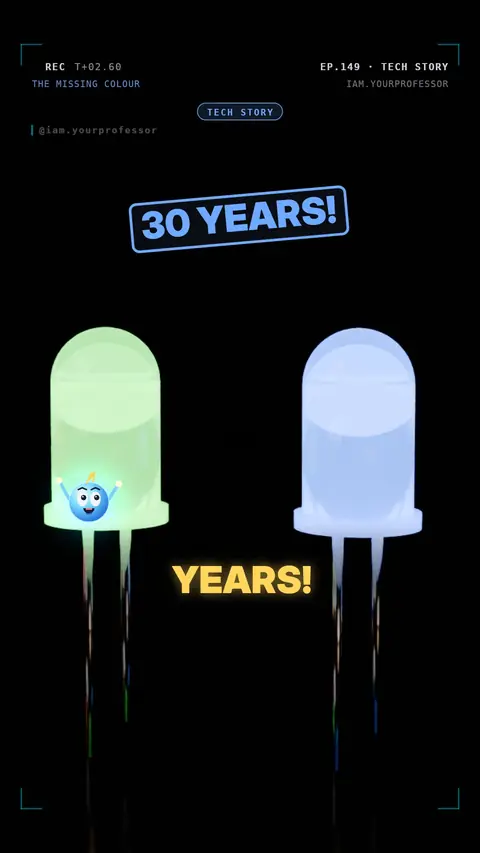
The blue LED took 30 years (Akasaki, Amano, Nakamura — Nobel Prize 2014) and made white LEDs possible.
Red and green LEDs were easy. Blue took 30 years! 💙
1962: the first red LED. But without blue, there was no white LED light.
The material for blue — gallium nitride (GaN) — was too hard to grow as a good crystal. Most labs gave up.
Isamu Akasaki and Hiroshi Amano kept going. 1989: the first blue glow (still dim).
Then Shuji Nakamura, at a small Japanese company (Nichia), made it bright — 1993! ✨
All three won the Nobel Prize in Physics in 2014. 🏅
Blue light + a yellow coating (phosphor) = white light → every white LED bulb, phone flash and screen backlight today. 💡
Read the voiceover (transcript)
- Red and green LEDs were easy. Blue took thirty years!
- Nineteen sixty-two: red LEDs. Blue? Nobody could make it.
- Its crystal, gallium nitride, was too hard to grow!
- Akasaki and Amano kept going. Nineteen eighty-nine: a blue glow!
- Then Nakamura, at a small company, made it bright!
- Blue plus yellow makes white: every LED bulb!
- Next story: why is it called Arduino? Follow for more!
Related lessons
 EP.108 · Tech StoryTech Story #3: The war of the currents — Edison's DC vs Tesla + Westinghouse's AC
 EP.86 · Tech StoryTech Story: the transistor that changed everything
 EP.71 · Tech StoryTech Story: the first computer bug was a real moth
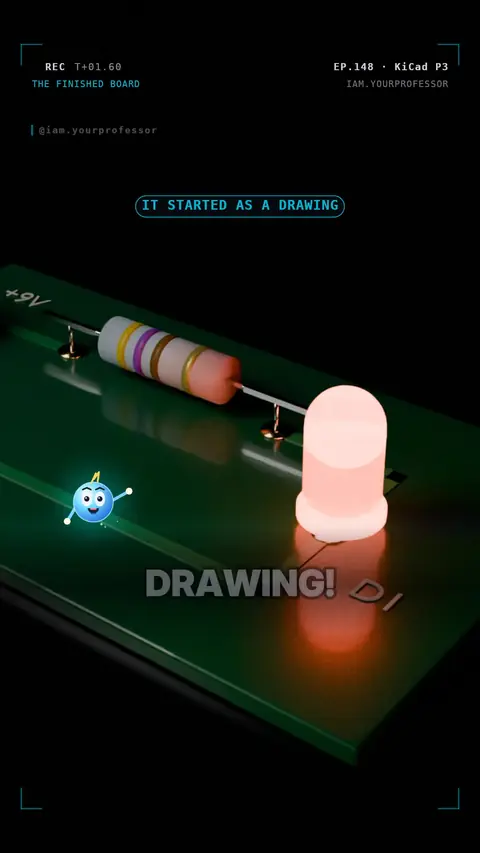 EP.148 · PCB Design with KiCad · 3PCB Design with KiCad Part 3: Your first schematic — battery, resistor, LED
Get new lessons + early access to the full course
One email when new lessons drop. No spam, unsubscribe any time.
✓ You're on the list! We'll email you when new lessons drop.
By joining you agree to the privacy policy.