Explained Simply #5: How does your phone remember things with the power off?
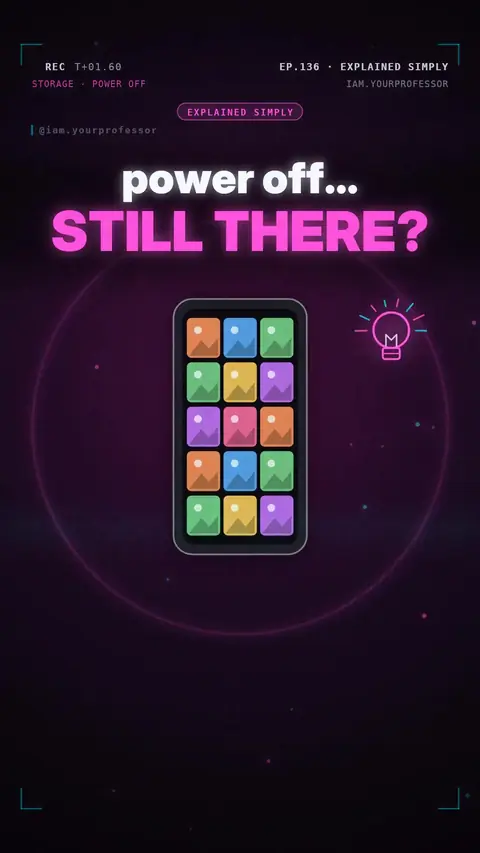
Flash memory traps electrons in a tiny insulated cell; trapped = 0, empty = 1, and they stay for years without power.
How does your phone remember your photos with the power off? 📸🔋 Explained simply 👇
1️⃣ FLASH MEMORY: your phone's storage is billions of tiny cells. Each one is like a little box with walls of glass (silicon dioxide — the same stuff glass is made of).
2️⃣ SAVING A BIT: a push of voltage forces electrons through the thin glass wall into the box. When the push stops, they're trapped inside!
3️⃣ READING IT: a box with trapped electrons means 0, an empty box means 1. The glass walls hold the electrons for years — no power needed.
Tiny boxes, trapped electrons — that's how it remembers!
(Your phone's RAM is different: it forgets everything when the power goes off.)
Read the voiceover (transcript)
- How does your phone remember with the power off?
- Flash memory! Billions of tiny cells, each one a little box with glass walls.
- To save a bit, a push of voltage forces electrons through the wall. Now they're trapped!
- Trapped means zero, empty means one. They stay put for years, even with no power!
- Tiny boxes, trapped electrons!
- Next: how solar panels make electricity! Follow for more!
Related lessons
 EP.111 · Explained SimplyExplained Simply #3: How does GPS know where you are?
 EP.103 · Explained SimplyExplained Simply #2: How does a computer think with just ON and OFF?
 EP.95 · Explained SimplyWhat is electricity, really?
 EP.135 · Chips · 5Chips Part 5: Big and little cores — how your phone saves battery
Get new lessons + early access to the full course
One email when new lessons drop. No spam, unsubscribe any time.
✓ You're on the list! We'll email you when new lessons drop.
By joining you agree to the privacy policy.