Why your phone charger got so small
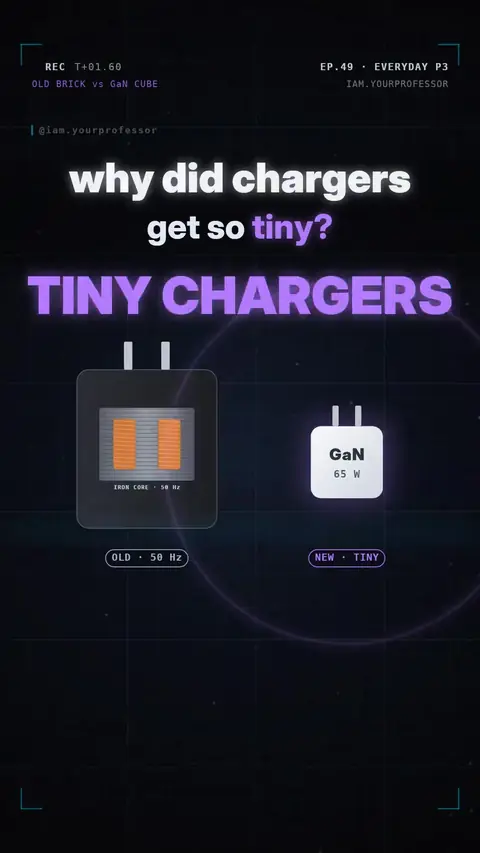
See how switch-mode chargers (and GaN) shrink a big 50 Hz transformer into a tiny fast one.
Why are new chargers SO tiny but still so powerful? 🔌⚡
1️⃣ THE OLD WAY: a big iron-core transformer working at mains speed (50 Hz), then diodes + a capacitor. A slow 50 Hz transformer needs lots of iron and copper → heavy, warm and wasteful.
2️⃣ THE NEW WAY (switch-mode): first turn 230 V AC into DC (about 325 V), then a transistor chops it on/off around 100,000 times a second. At that high frequency the transformer can be TINY (a small ferrite core). Then it's rectified and smoothed to a steady 5 V (or more for fast charging), with feedback keeping it exact.
3️⃣ GaN: gallium nitride transistors switch even faster and waste less heat than silicon, so 65 W now fits in a pocket-size cube.
📌 Higher frequency = smaller transformer = tiny charger.
Read the voiceover (transcript)
- Why did chargers get so tiny?!
- Old chargers used a big iron transformer at fifty hertz. Heavy, and hot!
- New ones turn AC into DC, then chop it a hundred thousand times a second. Faster means a much smaller transformer!
- Gallium nitride switches even faster, and wastes less heat!
- Higher frequency, tiny charger!
- Next: wireless charging! Follow for part four!
Related lessons

Get new lessons + early access to the full course
One email when new lessons drop. No spam, unsubscribe any time.
✓ You're on the list. Check your inbox to confirm.
By joining you agree to the privacy policy.